 EN

Magnetic Whiteboards for Offices
Please tell us about your company's advantages and characteristics.
2026/10/02
Choosing an acrylic dry erase board is not simply a style decision. For a school facilities manager or office buyer, the surface affects everyday writing, cleaning effort, mounting choices, and the cost of replacing a board later. Clear acrylic can make a planning wall feel lighter and more modern; a standard white dry erase board is usually easier to read from across a room. The right answer depends on how often people write, whether magnets matter, and what the wall must do after the meeting or lesson ends.
Before comparing materials, define the use case. A reception-area task tracker, a design studio note board, and a classroom teaching surface may all be called whiteboards, but they are not asked to perform the same way. An acrylic dry erase board is often selected for its transparent, frameless look. A standard board usually refers to a white writing surface, commonly a coated steel or melamine-style panel, although specifications vary by supplier. Porcelain and glass are separate premium alternatives worth considering when writing frequency is high.
One question changes the recommendation quickly: will users write on the surface several times a day, or is it mainly a light-duty display? For occasional notes and visible wall aesthetics, acrylic can be a sensible fit. For a busy classroom or meeting room, prioritize erasability, contrast, and long-term resistance to wear over the initial visual effect.
| Decision factor | Acrylic dry erase board | Standard coated white board | Porcelain whiteboard |
|---|---|---|---|
| Appearance | Clear, floating, contemporary | High-contrast white, familiar | Opaque, professional, traditional |
| Writing visibility | Depends on wall color and lighting behind it | Usually strong contrast in most rooms | Usually strong contrast in most rooms |
| Scratch sensitivity | Needs gentle cleaning and careful handling | Varies by coating and quality | Generally suited to demanding use |
| Magnetic options | Only if the construction specifically includes a magnetic backing | Often available on steel-backed versions | Often available on steel-backed versions |
| Best fit | Light-to-moderate writing, visual planning, modern interiors | General office and classroom use | High-frequency, long-term installations |
These are selection principles, not universal promises. Surface coatings, backing, marker compatibility, and installation hardware can make two boards made from the same base material behave very differently.
An acrylic dry erase board has a smooth, glossy feel and lets the wall behind it remain part of the design. That transparency is also its main trade-off. Dark paint, patterned walls, windows, and overhead lights can reduce marker contrast or create glare. If a group needs to read notes from several seats away, test marker colors against the actual background before ordering.
A white standard board gives the marker a consistent visual field, which is why it remains practical for lessons, training, and recurring team meetings. Porcelain whiteboard surfaces are often shortlisted for demanding installations because buyers value their durable, nonporous writing surface. That does not mean every organization needs porcelain. If the board is used only for a weekly status meeting, a well-specified standard board may be the more proportionate choice.
For every surface, wipe fresh marks with a clean soft eraser or microfiber cloth. Use a cleaner that is suitable for the particular board when residue persists, and avoid abrasive pads. Fine scratches can trap pigment and make ghosting more noticeable. Acrylic deserves extra care here: do not assume that a clear sheet has the same scratch tolerance or dry-erase coating as a purpose-made acrylic dry erase board.
It is tempting to compare only the unit price. In practice, total cost includes mounting, cleaning time, the likelihood of surface replacement, and how disruptive a swap-out will be. A lower-cost board is not necessarily less economical, but it can become the expensive option when it no longer erases cleanly in a high-use room.
For a premium office feature wall, the visual value of acrylic may justify its care requirements. For training rooms, tutoring centers, and heavily scheduled classrooms, a porcelain whiteboard or a durable coated steel surface can be easier to defend because the board must remain readable after repeated use. Ask suppliers for the exact surface construction, warranty terms, recommended cleaning method, and whether marker residue or scratches are covered.
If you are reviewing whiteboards for sale for several sites, request a sample rather than comparing photographs alone. Write, erase, clean, and inspect the sample under the lighting and viewing distance that users will experience. This simple check also makes it easier to compare marker contrast on a clear board with contrast on a white surface.
Transparency does not automatically mean magnetism. A true magnetic acrylic dry erase board needs an engineered magnetic layer or backing; an acrylic face by itself will not hold magnets. Standard boards also vary, so confirm steel backing rather than relying on a catalog label. This matters if your workflow uses printed schedules, cards, or magnetic accessories.
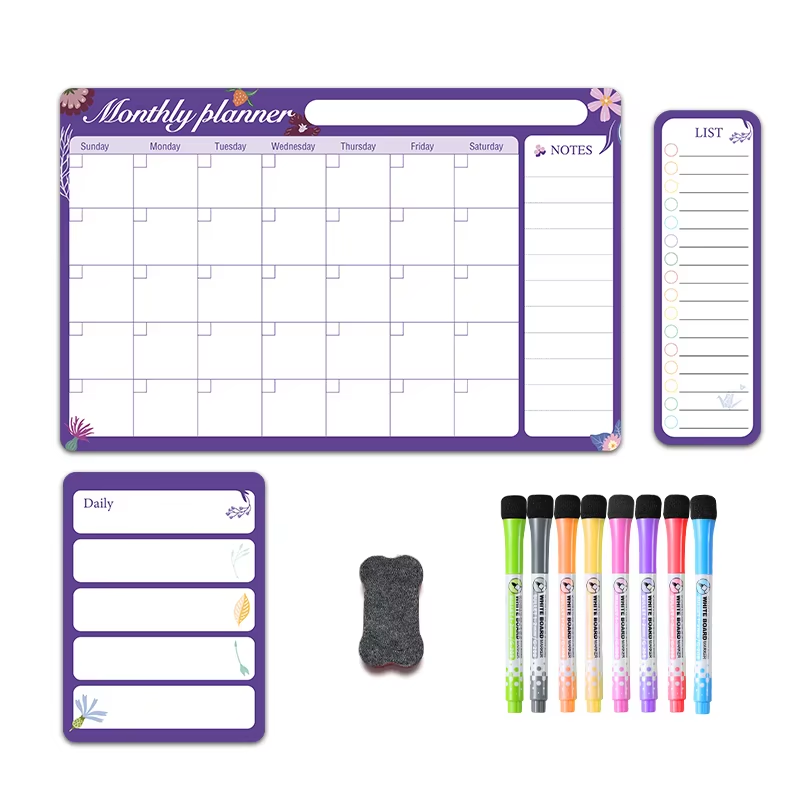
A planning application can favor different materials than a teaching wall. A week planner whiteboard often benefits from a white, high-contrast grid that remains easy to scan. A transparent acrylic board can work well for a small project dashboard where the wall color is controlled and the plan does not need magnets. In either case, decide whether the board is permanent or likely to move. Check wall type, fixing locations, board weight, and the clearance required for any stand-offs or frames before placing an order.
For buyers who need a magnetic option, the site’s customizable magnetic drywipe whiteboard is a relevant product category to review. Its listing supports a discussion of magnetic whiteboard procurement, but the final material, dimensions, and performance requirements should be confirmed with the supplier.
A porcelain whiteboard is usually considered when the board will be written on repeatedly, used by many people, or expected to stay in one place for years. Its higher upfront cost may be reasonable when replacement, downtime, or cleaning labor would be more costly over the life of the installation. It is not automatically the right choice for every wall. Weight, mounting requirements, budget, and the need for a transparent design can point in another direction.
For organizations standardizing boards across classrooms, meeting spaces, and staff areas, document the chosen surface, magnetic requirement, mounting method, and cleaning routine. Consistent specifications make replacement and maintenance easier than allowing each room to select a different product independently.
An acrylic dry erase board is a strong choice when a clear, architectural look and light-to-moderate writing are central to the project. A standard white board is usually the more versatile option where legibility and everyday practicality lead. For intensive, long-term use, porcelain is worth evaluating alongside durable steel-backed boards. Select the surface after checking the room, writing frequency, magnetic needs, installation constraints, and maintenance plan; that approach produces a board users will still want to write on months after installation.

2026/08/20
Unlock flexible, repositionable whiteboarding for education, agile offices, retail, healthcare & more. Cuttable, magnetic, certified — request your free B2B sample today.

2026/10/10
Discover the 2027 Texture Magnetic Collection & Exclusive Exhibition Promotions Dear Global Partners and Valued Clients, We are thrilled to announce that Shenzhen U&U Magnetic Technology Co., Ltd. (Brand: UCMD) will be officially exhibiting...

2026/08/19
Discover how UCMD® leverages the Canton Fair to showcase magnetic educational & lifestyle products, build global buyer trust, and drive OEM/ODM partnerships. Explore our certified, customizable solutions today.

2026/08/28
Our Commitment to People, Planet & IntegrityAt ShenZhen U&U Magnetic Technology Co., Ltd. (UCMD®), we believe that how we make our products matters as much as what we make. From our factory floor in Shenzhen's Bao An District to the hands...

Please tell us about your company's advantages and characteristics.

Please tell us about your company's advantages and characteristics.

Please tell us about your company's advantages and characteristics.

Please tell us about your company's advantages and characteristics.

Please tell us about your company's advantages and characteristics.

Please tell us about your company's advantages and characteristics.

