 EN

Magnetic Whiteboards for Offices
Please tell us about your company's advantages and characteristics.
2026/10/13
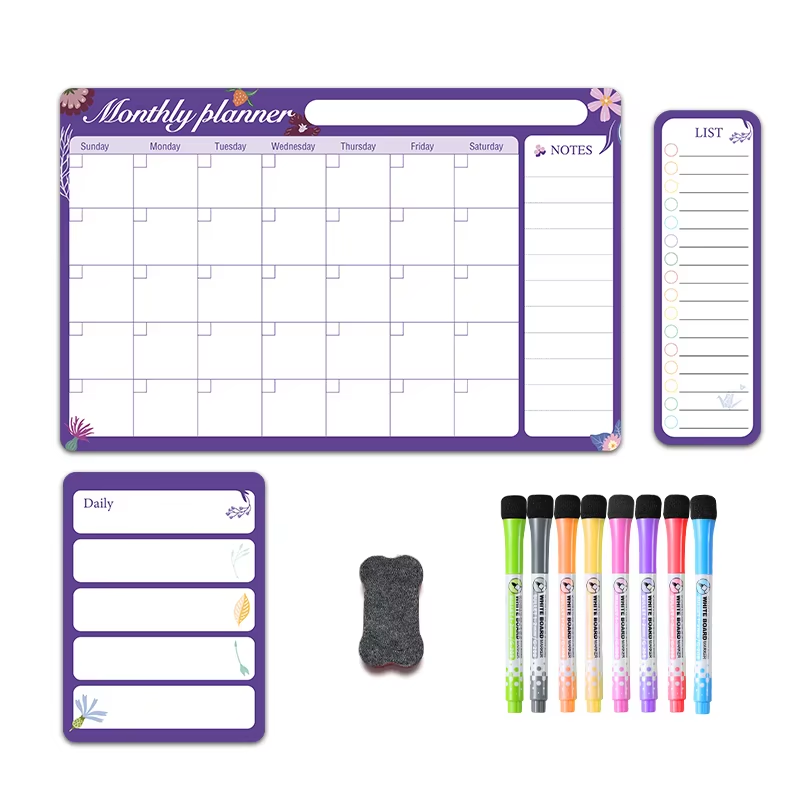
A big dry erase calendar turns planning into something a whole group can see, question, and update together. That difference matters in a busy classroom, a project room, or a family kitchen where several schedules overlap. A compact planner can hold dates; a larger planning surface makes priorities visible before they become missed handoffs.
As a buyer responsible for shared learning or work spaces, it helps to start with the room rather than the product listing. Who needs to read the calendar from across the room? How many people add information? Does the board need to stay on a wall, travel between meetings, or sit on a refrigerator? Those answers determine whether a big dry erase calendar is useful space or simply an oversized object.
The most obvious advantage of a big dry erase calendar is writing room. A monthly cell can carry an event title, an owner, a deadline, and a simple color cue without turning into a blur. That is especially helpful when a calendar supports more than one person. Instead of keeping separate private notes and reconstructing the plan later, the group can use one visible source of truth.
Size also improves scanability. Readers can stand back and recognize the rhythm of a month: busy weeks, open capacity, school breaks, delivery dates, and project milestones. General display-legibility guidance makes the underlying point clear: text needs to scale with the distance of the farthest viewer. For a planning board, that means measuring where people will actually stand before treating a larger format as automatically better.
A big dry erase calendar can also reduce friction during updates. With broad day boxes, people are less likely to overwrite each other or use cramped abbreviations that no one remembers later. Still, a bigger format is not necessarily the right fit. A calendar placed too high, too far from the people using it, or in a narrow passage may become background decoration instead of a working tool.
| Format | Best fit | What to check |
|---|---|---|
| A3 | Desks, refrigerators, small teams, and individual weekly or monthly planning | Make sure day boxes remain large enough for the number of entries expected. |
| A2 | Family command centers, small classrooms, and compact meeting rooms | Confirm wall space, mounting position, and clear viewing lanes. |
| Larger wall formats | Classrooms, departments, production areas, and shared project rooms | Plan the layout, the farthest viewing point, and safe handling during installation. |
An A3 board is often practical when one or two people need a close-up view. It can be a sensible starting point for a desk or refrigerator. For example, an A3 size dry erase calendar for refrigerator, office, or desktop use is a relevant option when the planner will be read at arm’s length rather than across a room.
An A2 or larger big dry erase calendar gives each day enough space to support a shared system. In a classroom, that may mean room for assignments, special events, and rotating responsibilities. In a meeting room, it may mean a clear view of deadlines, staffing, and review dates. The question is not whether a larger board looks more impressive; it is whether it lets the audience read and act on the plan without crowding around it.
A small board encourages a minimalist schedule. That can be an advantage if the goal is to show only the most important dates. A big dry erase calendar, by contrast, supports layered information: recurring work, milestones, owners, and visual categories can live together. The risk is that more room invites more noise.
Use a simple visual language to keep the larger surface useful:
A decorative dry erase calendar can make a shared wall feel more welcoming, but visual styling should not reduce contrast or writing space. First impressions can favor a pleasant frame or bright design; in daily use, readable cells and an easy-to-clean surface usually matter more. If your calendar is used under glare-prone lighting, ask for a finish that supports clear reading rather than assuming every white surface performs the same way.
For a classroom, a big dry erase calendar is most effective when students can see it during normal instruction. Plan for consistent headings, large writing, and a clear boundary between schoolwide dates and class-specific tasks. Teachers should decide whether students will write on it directly; if they will, leave enough open space and choose markers that erase cleanly under frequent use.
In a project room, the big dry erase calendar should make decisions easier, not replace a detailed task system. Use it for dates that benefit from collective visibility: launches, approvals, handoffs, travel, and capacity constraints. A large monthly dry erase calendar is especially helpful when leaders need to see timing conflicts at a glance while working through a monthly review.
A big dry erase calendar helps households coordinate school activities, appointments, visitors, and meal plans. A magnetic format may suit a refrigerator, while a hanging dry erase calendar can serve a hallway or entry area. Put the board where family members naturally pass it, not where it merely fits an empty wall.
For bulk orders, the value of a big dry erase calendar depends partly on how it arrives. Larger flat boards have more exposed edges and a greater chance of surface damage when packed loosely. Buyers should ask suppliers about individual protection, corner protection, inner spacing, carton strength, pallet stability, and whether the chosen size changes the shipping method.
Corner boards are commonly used in packaging to protect edges and help stabilize a load. That principle is useful here: protect corners, prevent board-to-board abrasion, and avoid placing heavy items where they can flex the calendar surface. If an organization is ordering multiple rooms at once, standardizing dimensions can also simplify cartons, replacement planning, and installation instructions. An oversized board that arrives damaged or cannot be mounted consistently is not a planning upgrade.
The right big dry erase calendar is not defined by a single dimension. It is defined by whether its writing area, visibility, and placement make the next decision easier. Start with the people who will use it, size it for the information they need to see, and treat packaging and mounting as part of the planning system—not an afterthought.

2026/08/20
Unlock flexible, repositionable whiteboarding for education, agile offices, retail, healthcare & more. Cuttable, magnetic, certified — request your free B2B sample today.

2026/10/10
Discover the 2027 Texture Magnetic Collection & Exclusive Exhibition Promotions Dear Global Partners and Valued Clients, We are thrilled to announce that Shenzhen U&U Magnetic Technology Co., Ltd. (Brand: UCMD) will be officially exhibiting...

2026/08/19
Discover how UCMD® leverages the Canton Fair to showcase magnetic educational & lifestyle products, build global buyer trust, and drive OEM/ODM partnerships. Explore our certified, customizable solutions today.

2026/08/28
Our Commitment to People, Planet & IntegrityAt ShenZhen U&U Magnetic Technology Co., Ltd. (UCMD®), we believe that how we make our products matters as much as what we make. From our factory floor in Shenzhen's Bao An District to the hands...

Please tell us about your company's advantages and characteristics.

Please tell us about your company's advantages and characteristics.

Please tell us about your company's advantages and characteristics.

Please tell us about your company's advantages and characteristics.

Please tell us about your company's advantages and characteristics.

Please tell us about your company's advantages and characteristics.

