 EN

Magnetic Whiteboards for Offices
Please tell us about your company's advantages and characteristics.
2026/09/29
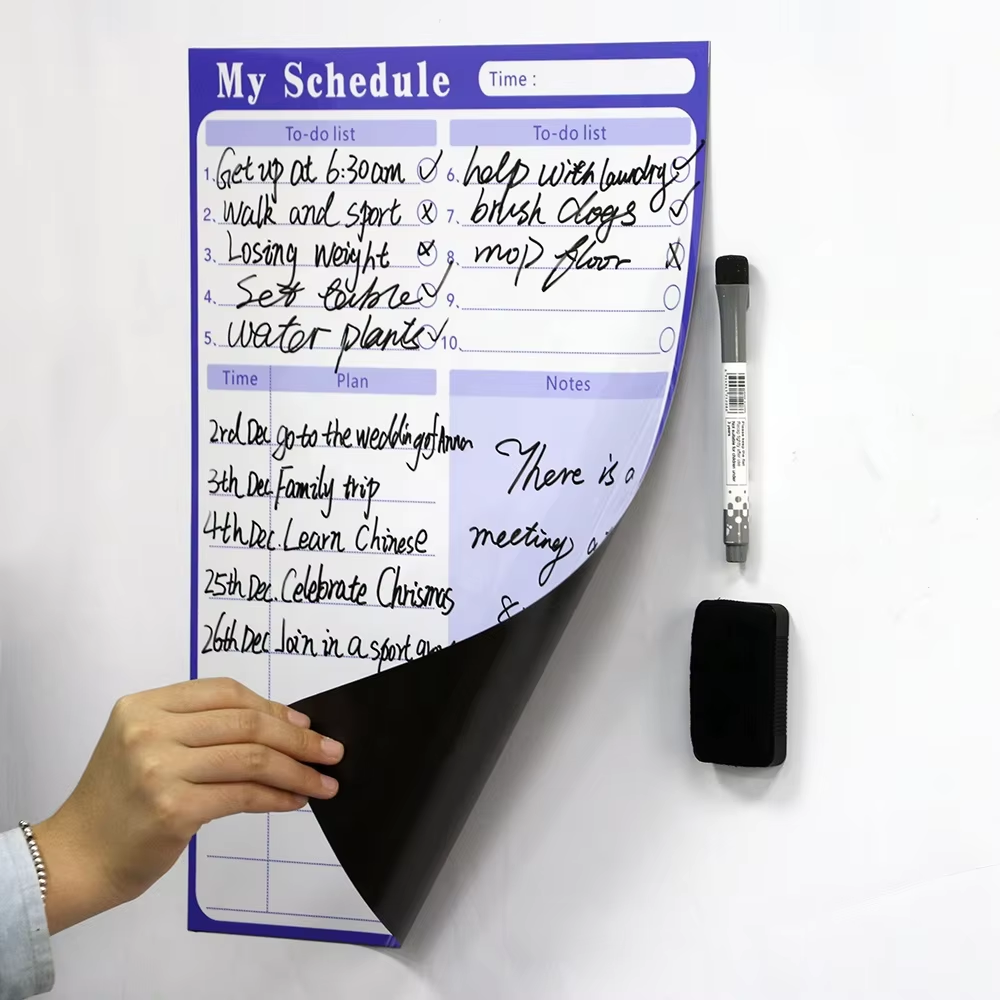
A daily and weekly planner is not simply a place to write tasks. It is a visible decision tool: it shows what must happen now, what can wait, and what needs to be seen by other people. For households, teams, retailers, and B2B buyers, the useful question is not “Which layout is best?” but “Which planning horizon fits the work?”
As a distributor choosing planning products for varied customers, I would start with the real rhythm of use. A daily and weekly planner can be paper, digital, or reusable and magnetic. The format matters more than the surface alone. Daily pages provide close-up task control; weekly views reveal competing priorities before the week gets crowded.
A daily format gives one day enough room for appointments, task lists, notes, and time blocks. It works well when a person has many changing commitments, a detailed study schedule, or a long action list. A weekly format places several days in one view, making it easier to balance deadlines, errands, meetings, and personal time. Search results on planner formats reflect this same distinction: daily layouts emphasize immediate-priority clarity, while weekly layouts are commonly used to view competing priorities.
The choice is not permanent. Many effective routines combine both. A daily and weekly planner can use a weekly board for the household or team overview and a smaller daily list for execution. This approach avoids copying every item into every space.
| Choose a daily view when | Choose a weekly view when |
|---|---|
| Appointments change often or time blocks matter. | You need to compare priorities across several days. |
| One person needs detailed control of a busy day. | A family, class, or team needs a shared visual overview. |
| Tasks must be broken into next actions. | You plan recurring routines, deadlines, or assignments. |
Paper planners travel easily, and digital calendars can send reminders. A reusable magnetic daily and weekly planner, however, keeps the plan where people naturally look: on a refrigerator, filing cabinet, or other magnetic surface. That visibility is valuable when a schedule needs to be shared rather than hidden in an app.
For a kitchen or home office, a monthly overview plus weekly action area often works better than a page-per-day format. For a reception area or shared workspace, a clear weekly board makes handoffs easier to see. If the board is used frequently, confirm the available magnetic area, marker compatibility, writing space, and whether the layout can be read from its intended viewing distance. Bigger is not automatically better; a board that fits the available surface and has enough room for real handwriting is the better choice.
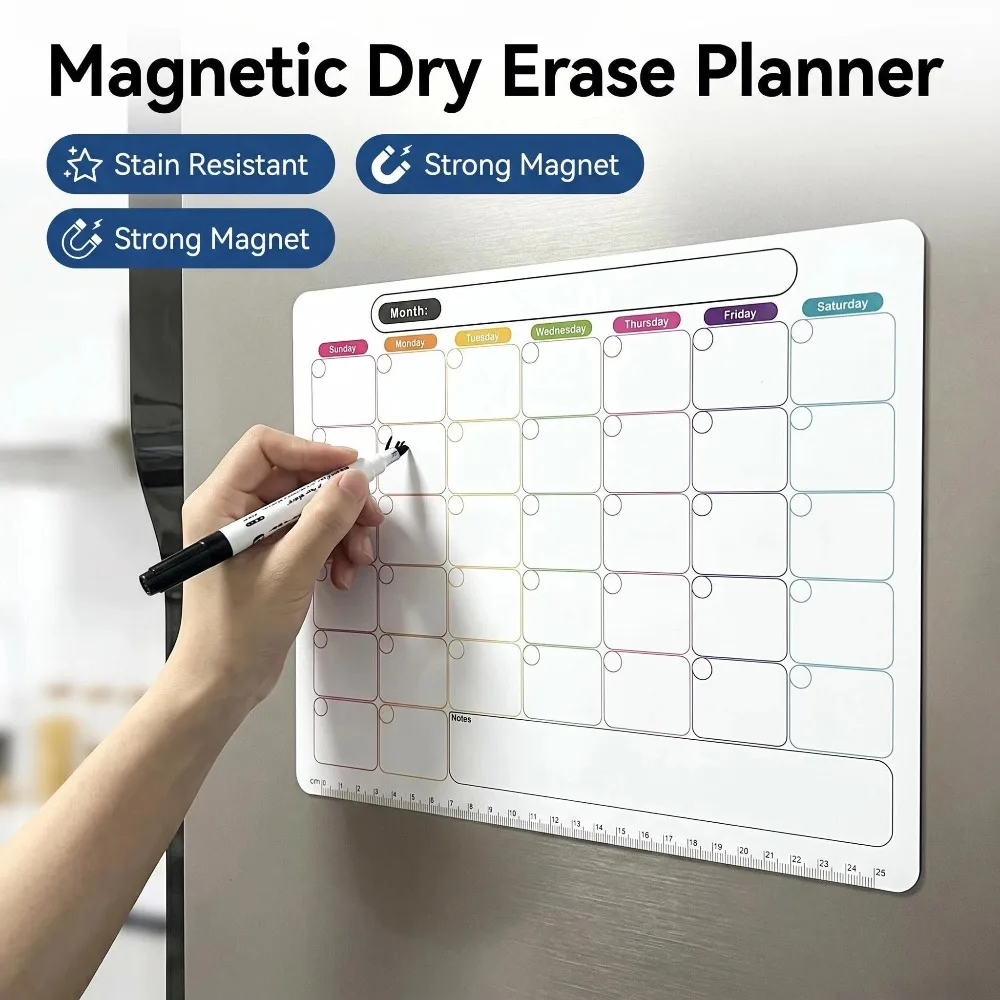
Ask what the user must decide at a glance. A daily and weekly planner with hourly rows suits appointment-heavy work. A weekly grid is a stronger fit for recurring classes, project milestones, meal planning, or rotating shifts. A weekly study planner is useful when learners need to spread assignments across subjects without losing sight of the whole week.
For a fridge, choose a reusable magnetic format that makes upcoming commitments visible to everyone who shares the space. For a desk, a weekly desk planner can keep the current week within reach without occupying a screen. Retail buyers should evaluate whether their customers want a compact personal board, a family calendar, or a larger office display. B2B buyers should standardize the sizes and layouts that match the intended installation surfaces rather than ordering by appearance alone.
A dry-erase daily and weekly planner is suited to schedules that change frequently. It reduces the friction of revising a plan, but it also requires a sensible care routine. Use dry-erase markers as directed, erase regularly, and follow the supplier’s care instructions before trying a cleaner. General dry-erase care guidance identifies diluted vinegar and water as one possible cleaning approach, but buyers should test a small area first and avoid assuming that every surface has the same finish.
For retailers and organizations, a daily and weekly planner can be more useful when its headings match the audience: shift planning, schoolwork, meal planning, project tasks, or family activities. OEM discussions should focus on confirmed requirements such as dimensions, layout, language, logo placement, packaging, and marker or accessory needs. Do not treat a mock-up as proof that a feature or material is available; confirm the final specification with the supplier.
Buyers looking for a fridge-centered combination layout can review the Reusable Magnetic Fridge Calendar Monthly & Weekly Planner with Dry Erase Markers for Kitchen Organization. It is relevant when the goal is to compare a combined monthly and weekly format with a shared-home use case.
For an office or home setup that favors a removable planning surface, see the Reusable Silicone Calendar Removable Weekly and Monthly Planner with To-Do List for Office and Home Use. For a weekly board option, the Weekly Planner Magnetic Board Dry Erase Monthly Planner Whiteboard for Fridge provides a product reference to assess against the available display surface and planned workflow.
Choose a daily layout if detailed scheduling is the source of missed tasks. Choose a weekly layout if visibility across several days is the source of better decisions. Choose a combined magnetic daily and weekly planner when people need a shared, editable plan in a fixed location. For seasonal displays or gift-led retail programs, related products such as christmas magnets for refrigerator may support visual merchandising, but they should not replace a functional planning layout.
Finally, test the planner with a typical week before committing to a large order. Write real appointments, tasks, and recurring events into the proposed layout. If the information feels cramped, hard to scan, or too easy to ignore, change the format—not just the color. That small test gives buyers a more reliable basis for choosing a daily and weekly planner that people will actually use.

2026/08/20
Unlock flexible, repositionable whiteboarding for education, agile offices, retail, healthcare & more. Cuttable, magnetic, certified — request your free B2B sample today.

2026/10/10
Discover the 2027 Texture Magnetic Collection & Exclusive Exhibition Promotions Dear Global Partners and Valued Clients, We are thrilled to announce that Shenzhen U&U Magnetic Technology Co., Ltd. (Brand: UCMD) will be officially exhibiting...

2026/08/19
Discover how UCMD® leverages the Canton Fair to showcase magnetic educational & lifestyle products, build global buyer trust, and drive OEM/ODM partnerships. Explore our certified, customizable solutions today.

2026/08/28
Our Commitment to People, Planet & IntegrityAt ShenZhen U&U Magnetic Technology Co., Ltd. (UCMD®), we believe that how we make our products matters as much as what we make. From our factory floor in Shenzhen's Bao An District to the hands...

Please tell us about your company's advantages and characteristics.

Please tell us about your company's advantages and characteristics.

Please tell us about your company's advantages and characteristics.

Please tell us about your company's advantages and characteristics.

Please tell us about your company's advantages and characteristics.

Please tell us about your company's advantages and characteristics.

