 EN

Magnetic Whiteboards for Offices
Please tell us about your company's advantages and characteristics.
2026/09/29
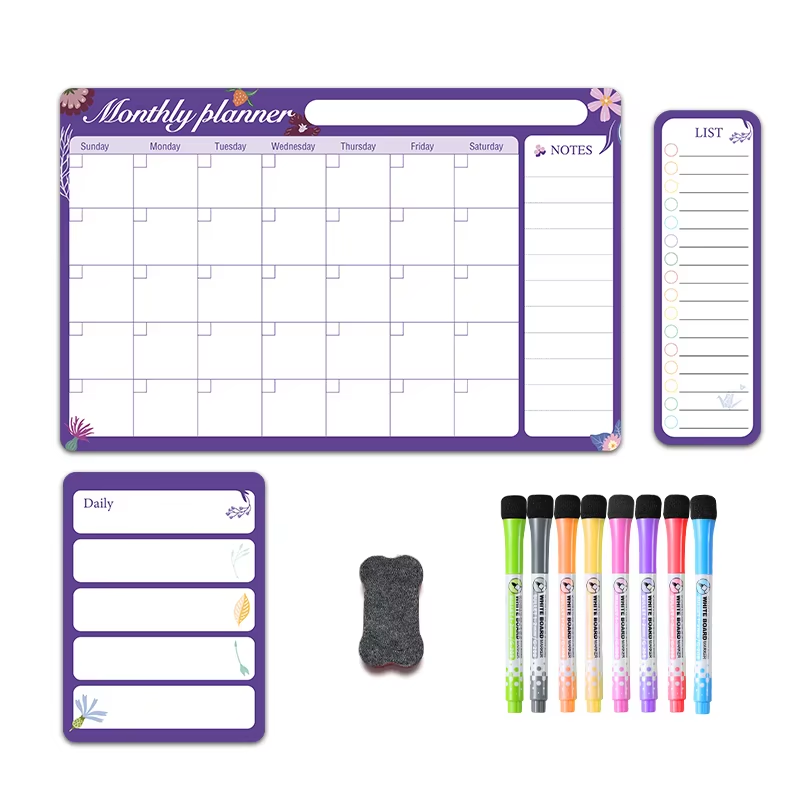
Choosing a daily weekly planner is less about finding one universally better layout and more about deciding what must stay visible when your schedule changes. A daily page gives a single date generous room; a weekly view puts competing appointments, routines, and deadlines in one frame. For households, offices, and retail buyers considering reusable magnetic formats, that difference affects where the planner lives, how often it is updated, and which layout will actually be used.
As a distributor serving varied planning needs, the practical question is simple: do users need detail for each day, or do they need the whole week to remain visible at a glance? Start there, then choose the size, format, and custom options that support the answer.
| Format | Best when users need | Potential trade-off |
|---|---|---|
| Daily planner | Time blocks, task detail, and a focused view of one busy day | Less visibility across the rest of the week |
| Weekly planner | A shared overview of appointments, deadlines, meals, shifts, or school activities | Less writing space for each individual day |
| Monthly overview | Longer-range dates, campaigns, school events, and capacity planning | Not enough room for day-to-day actions |
A daily weekly planner system can combine these views rather than forcing an either-or decision. A monthly wall planner can hold fixed dates, while a weekly board handles the work that moves. A small daily list then captures the actions that matter today.
A daily layout is useful when one person has many commitments, needs to assign time blocks, or benefits from a visible task list. It suits a busy office coordinator, a student during exam periods, or a household manager juggling appointments and errands. The point is not to fill every line; it is to make the next decision obvious.
For a reusable magnetic planner, daily space is especially helpful when several people add notes throughout the day. Use short labels, color-coded magnets, or a small priority area. If the board sits on a refrigerator, placement matters: the writing area should be readable without moving other decorative magnets for refrigerator surfaces. That is a small operational detail, but it determines whether the board remains a planning tool instead of background décor.
A weekly format is often the more suitable choice when the central problem is coordination. Families can see pickup times and activities side by side. Teams can spot deadline conflicts before the week starts. Retail and office buyers can use a shared board for recurring shifts, delivery windows, or campaign milestones.
Weekly visibility also reduces the temptation to plan each day in isolation. Ask a practical question before choosing: can users understand their busiest day without hiding the rest of the week? If the answer is no, a weekly layout is usually the more useful first layer. A magnetic board makes this view easy to revise when plans change because entries can be erased and rewritten rather than abandoned on a fixed page.

A monthly wall planner is not a replacement for either daily or weekly planning. It gives the long view: launches, vacations, billing dates, school terms, and staffing patterns. For home and office settings, pairing a monthly overview with a weekly planner creates a useful rhythm. The monthly board answers “what is coming?”; the weekly board answers “what needs attention next?”
For retail buyers, that pairing can also create a clearer assortment story. A compact weekly magnetic planner may fit a refrigerator or personal workspace, while a larger monthly format supports family command centers, classrooms, and team areas. Buyers should confirm intended mounting surface, usable writing area, included accessories, and packaging requirements rather than assuming all planner boards serve the same job.
Paper planners are portable and private. Digital calendars are strong for reminders and remote access. Reusable magnetic planning tools offer a different benefit: a shared, physical display that remains visible at the point of use. That can be valuable when the goal is conversation and coordination rather than personal record keeping.
A practical option may be a mix. A phone calendar can send alerts, while a daily weekly planner board shows the household or team what is changing. Before buying in volume, define who updates the board, where it will be mounted, and whether the writing should be visible to one person or many. Those answers are more reliable than choosing solely by appearance.
For a concrete starting point, review a reusable magnetic fridge calendar with monthly and weekly planner areas when a household needs both timeframes in one visible location. A weekly planner magnetic board with a dry-erase monthly planner format is another confirmed on-site option to evaluate for the intended setting. Product selection should still be based on the current listing details and the buyer’s requirements.
For B2B and private-label programs, customization is most useful when it clarifies the workflow. A retailer may prefer locally familiar week-start conventions, a school supplier may need term-oriented labels, and an office buyer may want a branded header or dedicated project section. OEM and ODM discussions should focus on artwork, layout, dimensions, packaging, and the intended user journey. Avoid promising a format that has not been tested with real writing space and real mounting conditions.
A well-defined range can cover standard products and custom programs without making every order complex. The key is to standardize the decisions that affect usability: layout, material expectations, accessory needs, and how a user will clean and store the board.
Maintenance is straightforward but worth specifying. Use markers intended for the surface, erase recent writing regularly, and clean gently with a soft cloth according to the supplier’s care guidance. Avoid assuming that a household cleaner is suitable for every dry-erase surface. When evaluating samples, test the writing-and-erasing routine that customers will use most often, especially if the planner will stay in a kitchen, classroom, or high-touch office area.
For bulk programs, include concise care instructions in the product or packaging plan. This helps users protect the usable writing area and helps sellers set appropriate expectations about routine care.
Before a planner goes on a refrigerator, office wall, or retail shelf, make the timeframe decision visible in the product brief. A daily weekly planner can work well as a combined system when the daily section is used for immediate tasks and the weekly section holds shared commitments. If the product is intended as a monthly wall planner, reserve enough space for dates that are fixed well in advance instead of crowding it with every task.
This checklist also makes sampling more productive. Rather than asking whether a board looks attractive, ask whether a user can read a weekly commitment, add today’s action, and erase a changed plan without disrupting the rest of the schedule. That is the practical standard for a daily weekly planner.
Choose a daily format when detailed actions and time blocks are the main need. Choose a weekly format when coordination and a complete seven-day view matter most. Add a monthly wall planner when longer dates must stay visible. In many real settings, the strongest daily weekly planner solution is a layered one: monthly for direction, weekly for coordination, and daily space for immediate action.
For buyers, the final check is usability. Confirm the intended surface, layout, size, writing area, customization scope, and maintenance plan before placing a larger order. That framework supports a practical planner range without treating one timeframe as right for everyone.

2026/08/20
Unlock flexible, repositionable whiteboarding for education, agile offices, retail, healthcare & more. Cuttable, magnetic, certified — request your free B2B sample today.

2026/10/10
Discover the 2027 Texture Magnetic Collection & Exclusive Exhibition Promotions Dear Global Partners and Valued Clients, We are thrilled to announce that Shenzhen U&U Magnetic Technology Co., Ltd. (Brand: UCMD) will be officially exhibiting...

2026/08/19
Discover how UCMD® leverages the Canton Fair to showcase magnetic educational & lifestyle products, build global buyer trust, and drive OEM/ODM partnerships. Explore our certified, customizable solutions today.

2026/08/28
Our Commitment to People, Planet & IntegrityAt ShenZhen U&U Magnetic Technology Co., Ltd. (UCMD®), we believe that how we make our products matters as much as what we make. From our factory floor in Shenzhen's Bao An District to the hands...

Please tell us about your company's advantages and characteristics.

Please tell us about your company's advantages and characteristics.

Please tell us about your company's advantages and characteristics.

Please tell us about your company's advantages and characteristics.

Please tell us about your company's advantages and characteristics.

Please tell us about your company's advantages and characteristics.

