 EN

Magnetic Whiteboards for Offices
Please tell us about your company's advantages and characteristics.
2026/09/28
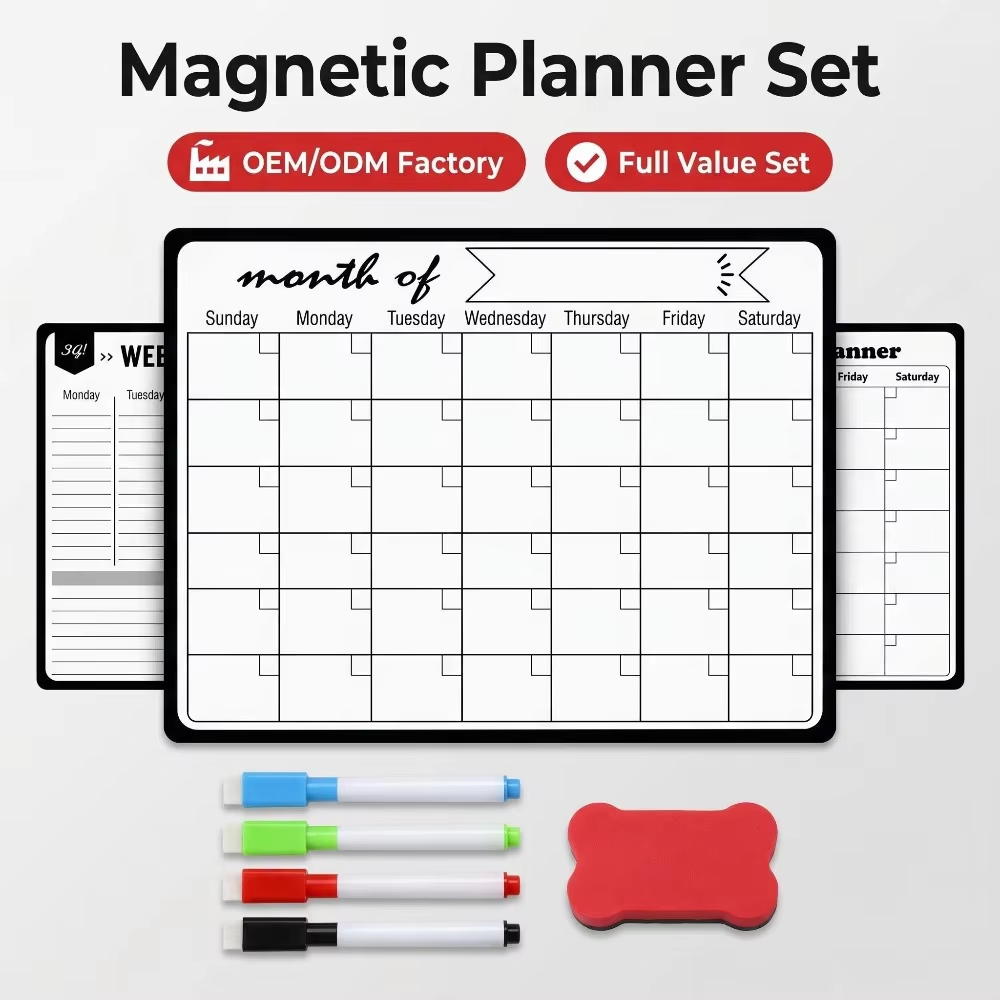
A daily weekly monthly planner is not really one format. It is a way to give different time horizons a place to work together. Daily pages help with immediate action, weekly pages reveal workload and sequence, and monthly pages show the commitments that can quietly crowd out a good plan. For an office-supply buyer, retailer, or team coordinator, that distinction matters because the most useful planner is the one that matches how people make decisions during a normal week.
As a buyer-facing comparison, this guide looks beyond a single notebook layout. A reusable magnetic board can bring the same daily weekly monthly planner logic into a shared kitchen, office, classroom, or operations area. The aim is not to insist that everyone needs all three views. It is to help you decide which view deserves the most space and when a combined format makes practical sense.
The strongest daily weekly monthly planner system assigns a distinct job to each horizon. Think of the monthly view as direction, the weekly view as coordination, and the daily view as execution. When one page is asked to do all three jobs, it often becomes either too crowded to read or too vague to guide action.
| Format | Best question it answers | Useful for | Common limitation |
|---|---|---|---|
| Daily | What needs attention today? | Appointments, task blocks, follow-ups, priority work | It can hide workload later in the week. |
| Weekly | What can realistically fit this week? | Team schedules, recurring duties, task sequencing | It may not show longer deadlines soon enough. |
| Monthly | What is coming and what must be protected? | Milestones, launches, leave, billing cycles, events | It usually lacks room for detailed next actions. |
This is why a daily weekly monthly planner can be more useful than choosing a winner. A monthly grid protects the big dates. A weekly spread turns those dates into capacity decisions. A daily list keeps the next step visible when the day gets busy.
Daily planning earns its space when people face many appointments, handoffs, or short tasks. In a daily weekly monthly planner, the daily area should answer three simple questions: what is fixed, what is important, and what can wait. That is especially helpful for administrative teams and households where interruptions are normal.
The trade-off is visibility. A detailed daily page can feel productive while concealing an overloaded Thursday or an approaching month-end deadline. If a user repeatedly rewrites the same task, the issue is usually not motivation. The daily weekly monthly planner may need a weekly view that exposes the actual available time.
Weekly planning is often the practical center of a daily weekly monthly planner. A seven-day span is long enough to balance meetings, delivery dates, school activities, and personal commitments, yet short enough to revise. It is also easier to spot whether a team has placed every urgent task on the same day.
For shared use, a weekly magnetic layout can be clearer than individual paper pages. The verified Weekly Planner Magnetic Board Dry Erase Monthly Planner Whiteboard for Fridge is a relevant first-party example of a reusable weekly-and-monthly format. A buyer should still confirm final size, layout, packaging, and material requirements with the supplier rather than inferring them from a title.
Weekly planning is more effective when it has a reset routine. Reserve a short time before the week begins to move monthly commitments into the week, estimate capacity, and leave a little blank space. In practice, a daily weekly monthly planner is more likely to be used when the board is updated in small, repeatable sessions rather than redesigned every Monday.
The monthly portion of a daily weekly monthly planner is a visibility tool. It is where launch dates, travel, holidays, payment cycles, staffing gaps, and major personal events can sit in one frame. That longer view prevents a week from being planned in isolation.
Monthly boxes do not need a full task list. Usually, a short label and a color cue are enough. The detailed work belongs in the weekly or daily view. This small boundary keeps a daily weekly monthly planner readable, which matters more than adding features nobody uses.

A combined daily weekly monthly planner board is worth considering when more than one person needs the same schedule. A household may use it for meals, activities, and school dates. An office may use it for visitor schedules, recurring operational checks, or project deadlines. A retailer can offer it as a reusable organization product rather than just another dated planner.
For example, the CMS-confirmed Reusable Magnetic Fridge Calendar Monthly & Weekly Planner with Dry Erase Markers for Kitchen Organization shows the kind of combined monthly-and-weekly concept that suits a visible shared surface. The CMS-confirmed Reusable Silicone Calendar Removable Weekly and Monthly Planner with To-Do List for Office and Home Use illustrates another first-party format with a to-do-list orientation.
The board choice should follow the use case. An adhesive dry erase board can suit a surface where a permanent mounting point is not desired. Mini dry erase boards may be better for departmental ownership or portable task zones. A white board with wood frame can fit a more decorative retail or home display concept, although appearance should not replace checks on usable writing area and mounting needs.
For office-supply channels, a daily weekly monthly planner range can be expanded through layout choices rather than unnecessary complexity. Useful questions include: Who updates it? Where will it be displayed? Does the buyer need weekly and monthly sections together? Which accessories are expected? Will the product be sold as a branded retail SKU or used internally?
Unufirm’s confirmed content-material context states that its magnetic planner range serves education and business applications and that OEM/ODM, branded printing, and product-development support are available. Those capabilities can support a buyer’s own brand program, but final artwork, minimum order quantity, lead time, compliance needs, and specifications should be confirmed during quotation.
Before scaling an assortment, test one real workflow. Put a monthly deadline at the top, add weekly commitments underneath, and assign only today’s next actions in the daily space. This test reveals whether the daily weekly monthly planner has enough usable room and whether the chosen markers, magnetic pieces, or accessories match the intended routine.
This routine gives a daily weekly monthly planner a clear hierarchy: month for perspective, week for commitments, day for action. It is modest by design, and that is its advantage.
Choose a primarily daily format when the user needs detail and accountability. Choose a weekly format when coordination and realistic workload matter most. Choose a monthly format when longer deadlines are frequently missed. Choose a combined daily weekly monthly planner when the same people need all three answers in one visible workflow.
A practical planner is not the one with the most boxes. It helps people see what matters at the right moment, revise without friction, and keep the next action obvious. For buyers, that is also a sound way to evaluate a planner assortment: start with the behavior the format must support, then select the layout, display method, and customization path that make that behavior easy to repeat.

2026/08/20
Unlock flexible, repositionable whiteboarding for education, agile offices, retail, healthcare & more. Cuttable, magnetic, certified — request your free B2B sample today.

2026/10/10
Discover the 2027 Texture Magnetic Collection & Exclusive Exhibition Promotions Dear Global Partners and Valued Clients, We are thrilled to announce that Shenzhen U&U Magnetic Technology Co., Ltd. (Brand: UCMD) will be officially exhibiting...

2026/08/19
Discover how UCMD® leverages the Canton Fair to showcase magnetic educational & lifestyle products, build global buyer trust, and drive OEM/ODM partnerships. Explore our certified, customizable solutions today.

2026/08/28
Our Commitment to People, Planet & IntegrityAt ShenZhen U&U Magnetic Technology Co., Ltd. (UCMD®), we believe that how we make our products matters as much as what we make. From our factory floor in Shenzhen's Bao An District to the hands...

Please tell us about your company's advantages and characteristics.

Please tell us about your company's advantages and characteristics.

Please tell us about your company's advantages and characteristics.

Please tell us about your company's advantages and characteristics.

Please tell us about your company's advantages and characteristics.

Please tell us about your company's advantages and characteristics.

