 EN

Magnetic Whiteboards for Offices
Please tell us about your company's advantages and characteristics.
2026/10/16
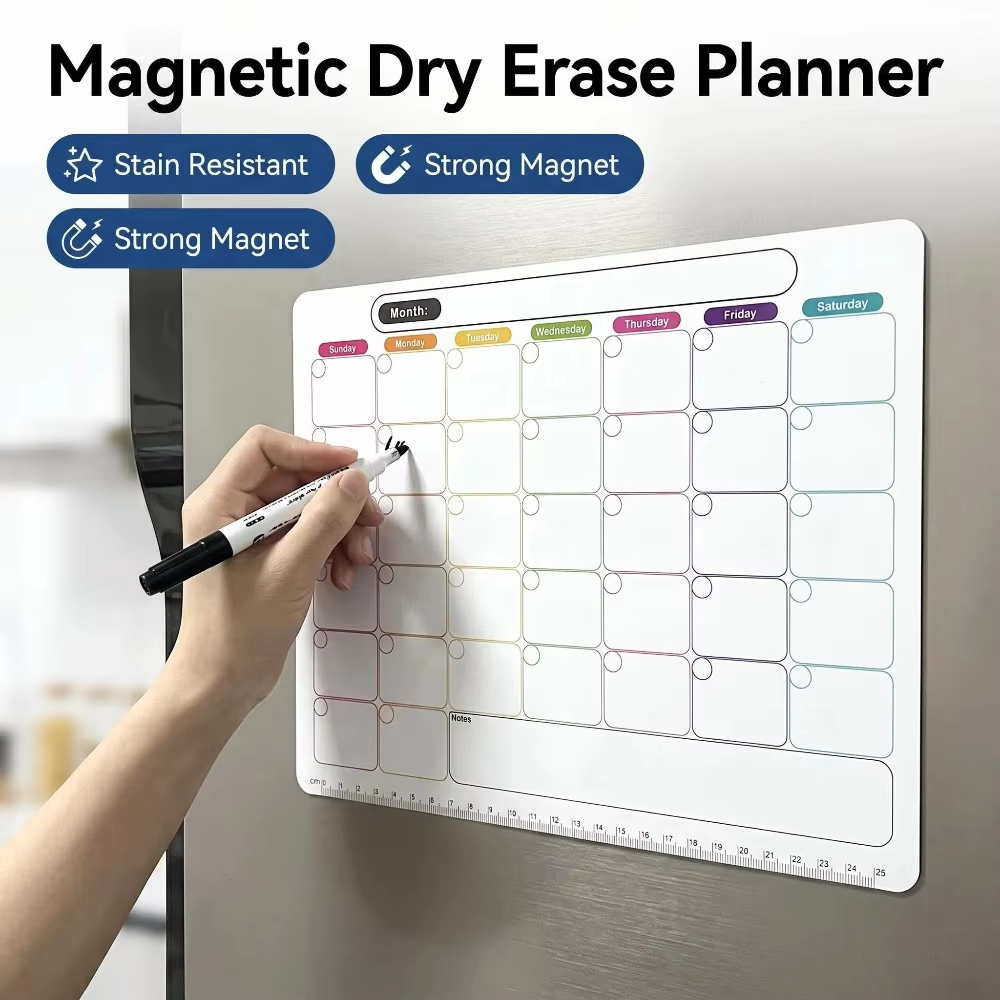
A dry erase board monthly calendar gives a school one visible place to coordinate the moving parts of a term. In a classroom, it can turn assessment dates, assemblies, clubs, room changes, and family events into a shared visual plan. For an education buyer, it is also a practical specification exercise: the board needs to be readable, cleanable, securely mounted, and easy for staff to update during a busy week.
This guide approaches the choice from both sides of the wall. Teachers need a calendar that supports routines; facilities and procurement teams need an item that can be evaluated consistently before a bulk order. The most useful result is not simply a larger grid. It is a planning surface that is placed, formatted, and maintained for the way a school actually works.
Before comparing finishes or frames, decide who will stand in front of the board and what decision they should be able to make. A classroom calendar may show homework deadlines, rotating duties, and upcoming learning milestones. A corridor calendar can highlight school-wide events. An office calendar may help administrators coordinate meetings, trips, testing windows, and visitor schedules.
That use case determines the amount of detail a dry erase board monthly calendar should carry. A crowded monthly grid becomes less useful when every square contains several lines. For high-detail work, pair the month view with a nearby weekly or notes section. This is where whiteboard week planner formats can complement a term calendar: the monthly grid holds dates that must stay visible, while the weekly area captures actions that change more often.
Most dry erase calendar boards use a seven-column month grid. That familiar pattern makes handovers easier because staff, students, and families already know where to look. A practical school layout usually reserves space for the month name, a notes column, and a small key for recurring markers such as exams, trips, or parent communications.
Some commercial examples use thirty-five day squares and a separate notes panel; that is a helpful layout reference, not a universal requirement. Ask staff to sketch one typical month first. If the sample month cannot be read from the back of the room, changing the board size or reducing the information load is more helpful than adding more decoration.
A large dry erase board monthly calendar is only effective when people can see it and reach it safely. Walk the intended wall before ordering. Check viewing distance, door swing, sunlight glare, electrical points, bulletin-board overlap, and whether students will stand near the board during transitions. A board that looks substantial in a catalog may be too small for a notice area or too wide for a classroom teaching wall.
Retail listings commonly show monthly boards in sizes such as 36 by 24 inches and 48 by 36 inches. Treat those measurements as comparison examples rather than a specification. Your order sheet should state the required visible writing area, overall frame size, orientation, wall type, and placement height. Facilities staff should also verify the supplied mounting method against the actual substrate and follow the manufacturer’s installation instructions. Do not assume that a fixing suitable for one wall will suit every classroom wall.

For a school, a dry erase board monthly calendar is handled repeatedly by different users. The most useful quality checks are simple and observable. Request a pre-production sample or clear evidence that lets the buyer examine the writing surface, printed grid alignment, frame corners, marker tray, backing, and mounting components. Test erasing after ordinary use rather than relying only on a product photo.
| What to verify | Why it matters in a school | Evidence to request |
|---|---|---|
| Writing and erase performance | Frequent updates should remain legible without distracting ghosting. | A sample, close-up video, or agreed inspection standard. |
| Printed month grid | Lines and labels need to remain clear after routine cleaning. | Artwork proof and a sample of the finished surface. |
| Frame and corners | Edges are exposed in high-traffic rooms and corridors. | Material description, corner detail, and packaging plan. |
| Mounting hardware | Safe installation depends on the board and the site wall together. | Hardware list, instructions, and wall-substrate confirmation. |
| Packaging and count | Bulk deliveries need to arrive organized for room-by-room installation. | Carton markings, quantity plan, and incoming-inspection checklist. |
Keep the language in purchase documents specific: require evidence and acceptance criteria instead of assuming a phrase such as “heavy duty” has one meaning. That approach also makes it easier to compare quotations fairly.
A school name, logo, house color, or term-label area can make dry erase calendar boards feel like a consistent part of the learning environment. Custom printing is usually most effective when it stays out of the daily writing space. Put a logo in the header or corner, then preserve strong contrast and generous blank areas inside each date box.
A sensible OEM workflow is straightforward: share the required dimensions and monthly layout, provide print-ready brand assets, review a digital proof, clarify the surface and mounting specification, then approve a sample or agreed pre-production evidence before the full run. Confirm what is included in the artwork, which fields will remain erasable, and how version changes are handled. This reduces the chance that a branded calendar looks attractive but is difficult to use after the first week.
After installation, the routine determines whether the board stays useful. Many teachers update the monthly view at the beginning of the week, then use a white board monthly calendar alongside a smaller weekly planning area for immediate tasks. Assign one person to update core dates, define the color key, and schedule a quick end-of-month reset. A photographed copy can help preserve the plan before the grid is cleared, subject to the school’s information-handling rules.
Start with a room plan and a sample month, then turn those into a written specification. For buyers reviewing related formats, the site’s teacher planner and student schedule organizer magnetic schedule board for classroom is a relevant example of a classroom-oriented schedule-board category. If a monthly and weekly format is needed for another setting, review the reusable magnetic fridge calendar monthly & weekly planner with dry erase markers as a separate product category rather than assuming it meets a school-wall specification.
The right dry erase board monthly calendar supports clear communication without becoming another maintenance task. When layout, wall placement, daily writing habits, and procurement checks all match the school’s workflow, the calendar becomes a reliable visual anchor for the term.

2026/08/20
Unlock flexible, repositionable whiteboarding for education, agile offices, retail, healthcare & more. Cuttable, magnetic, certified — request your free B2B sample today.

2026/10/10
Discover the 2027 Texture Magnetic Collection & Exclusive Exhibition Promotions Dear Global Partners and Valued Clients, We are thrilled to announce that Shenzhen U&U Magnetic Technology Co., Ltd. (Brand: UCMD) will be officially exhibiting...

2026/08/19
Discover how UCMD® leverages the Canton Fair to showcase magnetic educational & lifestyle products, build global buyer trust, and drive OEM/ODM partnerships. Explore our certified, customizable solutions today.

2026/08/28
Our Commitment to People, Planet & IntegrityAt ShenZhen U&U Magnetic Technology Co., Ltd. (UCMD®), we believe that how we make our products matters as much as what we make. From our factory floor in Shenzhen's Bao An District to the hands...

Please tell us about your company's advantages and characteristics.

Please tell us about your company's advantages and characteristics.

Please tell us about your company's advantages and characteristics.

Please tell us about your company's advantages and characteristics.

Please tell us about your company's advantages and characteristics.

Please tell us about your company's advantages and characteristics.

