 EN

Magnetic Whiteboards for Offices
Please tell us about your company's advantages and characteristics.
2026/10/02
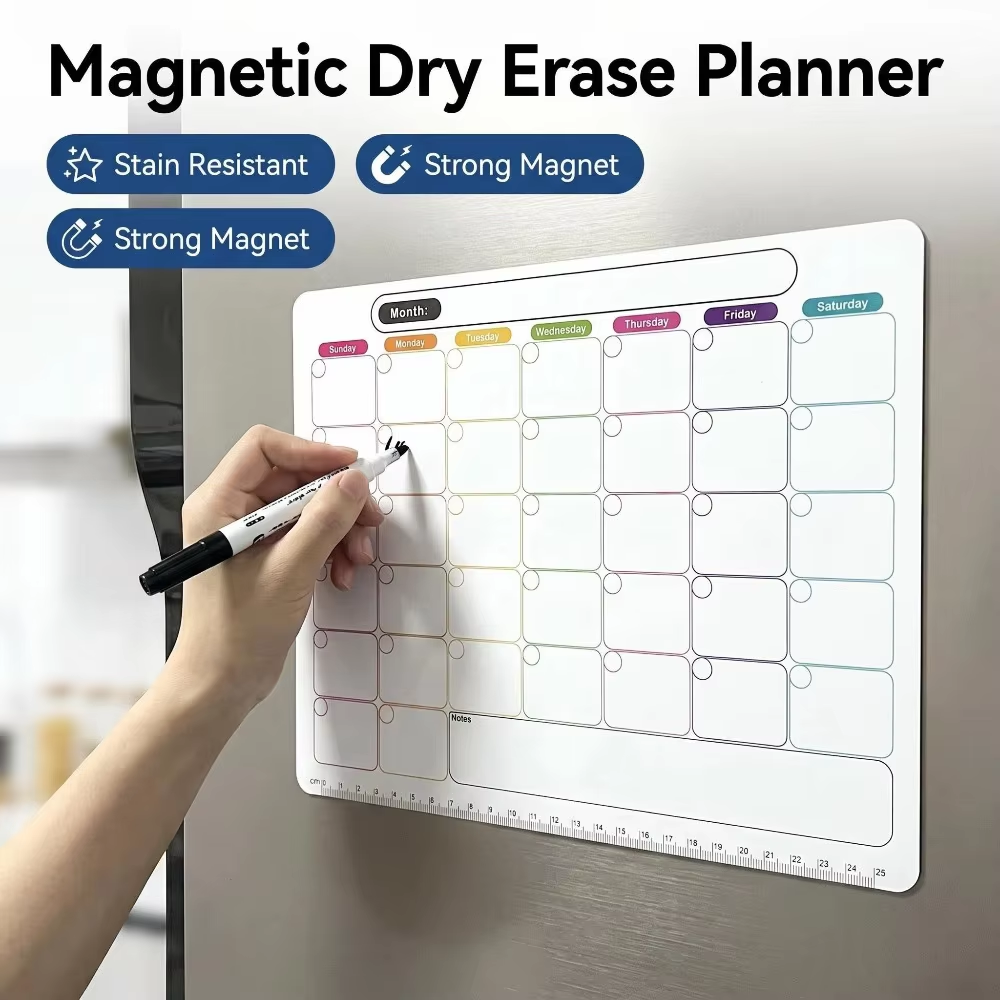
A dry erase board monthly calendar looks straightforward until you are choosing one for repeated use, a shared wall, or a purchasing program. The calendar grid matters, but so do the surface, mounting method, marker behavior, cleaning routine, and whether the format can be kept consistent as needs grow. For a distributor or organization buying more than one board, those details affect service calls and replacement costs as much as the unit price.
This guide separates the decisions that are often bundled together. It covers where a monthly calendar board works well, what different board constructions mean in practice, and how to evaluate a supplier or ready-made option without assuming that every planning wall needs the same solution.
The first question is not “Which surface has the highest specification?” It is “Who needs to read, write on, and update this calendar?” A fridge planner used by one household needs a different format from a team schedule in a break room or a classroom activity calendar. A practical dry erase monthly calendar should give each user enough writing room while remaining readable at the normal viewing distance.
Marketplace examples show both compact 16-by-12-inch planners and larger 36-by-24-inch or 48-by-36-inch board formats. Treat those as format examples rather than fixed rules. Measure the usable wall or appliance area, then sketch the grid and notes zone at full scale before committing to a size.
Many disappointing purchases are actually layout mismatches. A five-week grid with a notes panel may work well for appointment planning; a team may instead need a large monthly matrix plus a side column for deadlines. Check the following before comparing frames or finishes:
For example, an acrylic calendar listing in the search results describes 35 date squares and a dedicated notes area. That is a useful reminder to inspect the layout itself, not merely the headline dimensions.
Material affects appearance, magnetic usability, glare, cleaning habits, and lifecycle cost. There is no universal choice; the right dry erase board monthly calendar matches the space and the update frequency.
| Option | Where it fits | What to verify |
|---|---|---|
| Magnetic steel dry erase board | Shared offices, classrooms, refrigerator-compatible formats | Magnetic response, flatness, frame, mounting hardware, and writing/erasing performance |
| Porcelain-enamel steel board | High-use institutional or commercial planning walls | Specification from the supplier, installation method, and budget justification for frequent use |
| Glass calendar board | Design-led offices and reception areas | Glare, wall load, marker visibility, mounting system, and whether accessories are compatible |
| Acrylic calendar board | Home offices, studios, and spaces where a clear visual look matters | Print method, scratch care, wall standoff hardware, and the visibility of writing against the background |
A magnetic board is particularly useful when the calendar must carry cards, labels, or white board magnets in addition to marker notes. But do not assume “magnetic” means every magnet or attachment performs identically. Test the actual accessory set against the proposed surface, especially when planning pieces will be moved frequently.
It is tempting to buy the largest board available. In practice, the useful size is the one people can update without stretching, read without crowding, and install securely. Installation conditions and a future move plan are often more decisive than a small difference in board dimensions.
A monthly board only works when it stays visible and is easy to reset. Wall-mounted boards need the right substrate and hardware. Fridge planners need a reliably compatible metal surface. Portable or framed boards should be assessed for where they will be stored between uses.
Buyers sourcing a recurring format may also review a High Quality Magnetic Dry Erase Whiteboard Fridge Calendar Magnet as a reference point for a magnetic fridge-calendar format. For a planner-style presentation, the Weekly Planner Magnetic Board Dry Erase Monthly Planner Whiteboard for Fridge illustrates the type of product page a buyer can use when comparing layout and mounting needs. Product titles and links identify the available formats; confirm all final specifications directly with the supplier.
Use total cost of ownership rather than price alone. A lower-cost board can be sensible for occasional household planning. For a high-traffic office or school, early ghosting, poor mounting hardware, or an unreadable grid can create more cost than the initial saving.
Ask for a clear quote that distinguishes board size, surface construction, frame or standoffs, print customization, magnets or accessories, packaging, and any sample or tooling charges. If you need OEM or ODM work, share the intended environment and artwork early. A supplier with custom-development capability can help align dimensions and layout, but the buyer should still approve a proof and sample before a larger rollout.
A useful evaluation checklist is simple: inspect the surface under normal room lighting, write and erase a test area, test the selected magnets, check calendar-line legibility, and review the mounting kit against the actual wall. These checks reveal more than a generic “premium” label.
Regular care protects both readability and the perception of quality. Erase current writing before it sits for extended periods, use markers intended for dry erase surfaces, and follow the surface manufacturer’s cleaning instructions. Search guidance commonly points to purpose-made board cleaner or high-concentration isopropyl alcohol for stubborn residue; test any cleaner in an inconspicuous area first, particularly on an acrylic whiteboard or a board with printed graphics.
Do not use abrasive pads that can haze a clear surface or damage a coated one. Keep magnets clean and dry, and remove accessories that are no longer needed so the monthly view remains easy to scan. A short reset routine at the end of each month makes a dry erase monthly calendar more likely to remain a planning tool rather than a background fixture.
The most suitable dry erase board monthly calendar is the one that fits the planning behavior, viewing distance, mounting location, and maintenance capacity of its users. Begin with the grid and workflow, then compare magnetic steel, porcelain-enamel, glass, and acrylic options based on real use. For volume purchasing, standardize the layout and accessory list, validate a sample in the intended environment, and document the cleaning routine. That approach keeps the decision practical whether you are equipping a kitchen, a classroom, or a network of offices.

2026/08/20
Unlock flexible, repositionable whiteboarding for education, agile offices, retail, healthcare & more. Cuttable, magnetic, certified — request your free B2B sample today.

2026/10/10
Discover the 2027 Texture Magnetic Collection & Exclusive Exhibition Promotions Dear Global Partners and Valued Clients, We are thrilled to announce that Shenzhen U&U Magnetic Technology Co., Ltd. (Brand: UCMD) will be officially exhibiting...

2026/08/19
Discover how UCMD® leverages the Canton Fair to showcase magnetic educational & lifestyle products, build global buyer trust, and drive OEM/ODM partnerships. Explore our certified, customizable solutions today.

2026/08/28
Our Commitment to People, Planet & IntegrityAt ShenZhen U&U Magnetic Technology Co., Ltd. (UCMD®), we believe that how we make our products matters as much as what we make. From our factory floor in Shenzhen's Bao An District to the hands...

Please tell us about your company's advantages and characteristics.

Please tell us about your company's advantages and characteristics.

Please tell us about your company's advantages and characteristics.

Please tell us about your company's advantages and characteristics.

Please tell us about your company's advantages and characteristics.

Please tell us about your company's advantages and characteristics.

