 EN

Magnetic Whiteboards for Offices
Please tell us about your company's advantages and characteristics.
2026/10/07
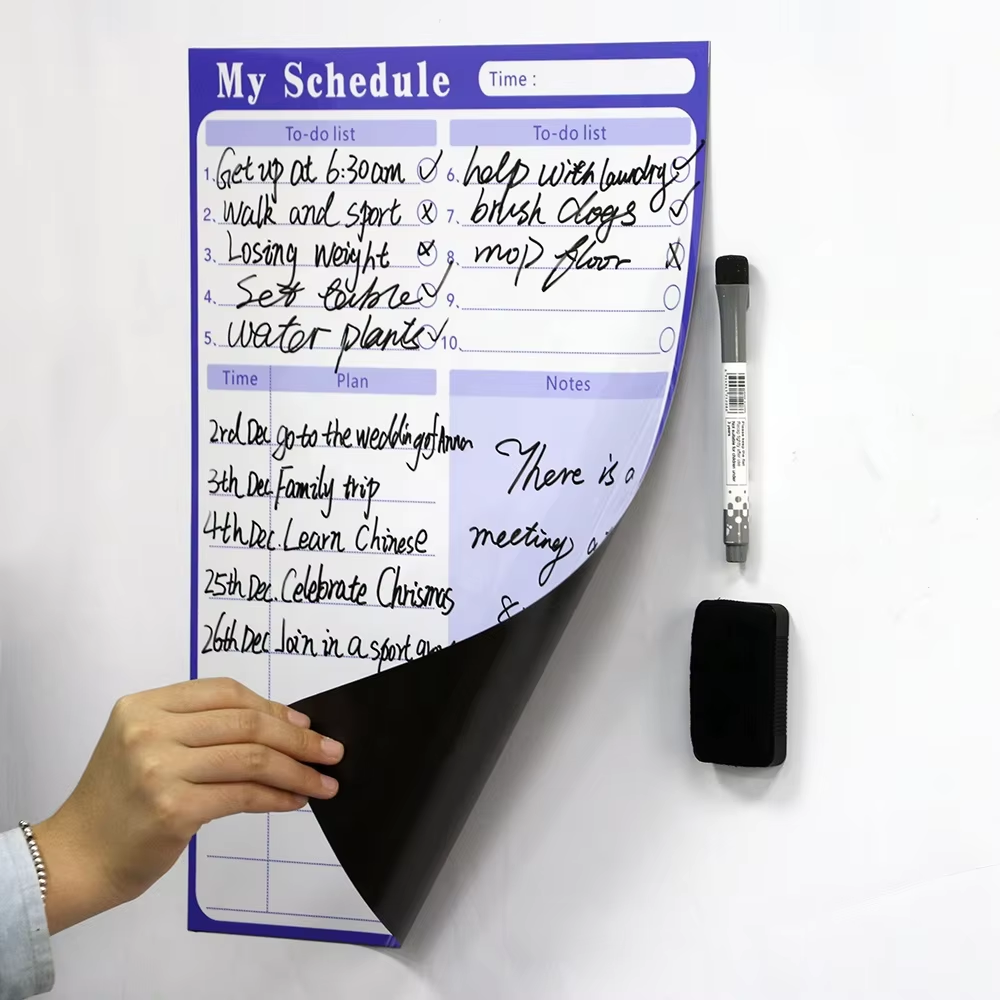
A dry erase board for office use is more than a blank surface for last-minute notes. In a meeting room, it can keep a project visible between calls. In a shared work area, it can turn priorities, owners, and blockers into something a team can see at a glance. The most useful boards do two jobs at once: they provide a clean writing surface and, when magnetic, they hold printed briefs, task cards, and visual planning pieces in the same place.
From a magnetic-material adviser’s point of view, the soundest choice starts with the work happening around the board, not with the frame color. A board that looks generous in a catalog may be too small for a weekly planning session; a low-cost surface may be fine for occasional visitor notes but frustrating for a team that erases and rewrites all day. This guide gives office buyers a practical way to compare the options.
Before comparing a dry erase board for office use, name the job it needs to do. A compact board near a desk works for individual priorities. A larger shared board suits a stand-up meeting, sprint planning, or a sales pipeline review. A reception or operations area may need a board that also displays printed notices. Once the workflow is clear, size, magnetic function, mounting, and surface material become easier to evaluate.
For active project work, magnetic capability is often the dividing line between a writing tool and a true visual-management tool. A traditional magnetic whiteboard uses a steel-backed writing surface, so magnets can hold documents and accessories directly on the board. That lets a team place a printed timeline beside handwritten decisions, move task cards during a meeting, or park reference sheets without covering the written plan. A display-only board can hold notices, but it cannot deliver that flexible write-and-arrange workflow.
Think about both usable writing area and viewing distance. A dry erase board for office meetings should give the facilitator room to write without repeatedly wiping key context, while people at the far end of the room should still be able to follow the headings. Measure the clear wall area, then account for doors, screens, furniture, and the reach of the person who will write on it.
Do not assume bigger is automatically better. A large board placed where nobody naturally looks becomes wall décor. A better approach is to map the board to the recurring meeting format: who writes, how many columns the team needs, and how long the information should remain visible.
A dry erase board for office planning earns its place when people can change information quickly. The writable face supports live thinking; the magnetic layer supports physical artifacts. That dual function is especially useful for schedules, project stages, product samples, printouts, and reusable labels. If a team relies only on permanent notices, a basic display board might be sufficient. If the board must host both changing notes and reference material, magnetic functionality deserves a place on the specification sheet.
Small magnetic formats can also support localized planning. A magnetic dry erase board for fridge may be useful in a staff kitchen or break area for shift reminders, supply lists, or informal announcements. It is not a substitute for a meeting-room board, but it can keep lightweight operational information visible where people already pause.
For larger installations, a whiteboard wall can make sense when the team needs a persistent collaboration zone rather than one movable object. Confirm the wall condition, joint placement, edge treatment, and installation method before choosing this route. A wall-scale solution is most effective when it has a clear use policy; otherwise, it can become a collection point for outdated notes.
Surface choice affects how the board feels months after installation. For occasional writing, a value-oriented coated surface may be appropriate. For frequent meeting use, ask more detailed questions about eraseability, stain resistance, scratch resistance, and the recommended cleaning routine. Porcelain or vitreous-enamel surfaces are commonly described as non-porous and highly resistant to staining; other surfaces, including painted steel or melamine, involve different durability and budget trade-offs. Rather than relying on a generic label, request the supplier’s surface specification and care guidance for the exact board under consideration.
This is where total cost matters. A lower purchase price may not be a saving if ghosting, difficult cleaning, or premature replacement interrupts a high-use workspace. Conversely, an intensive-use surface may be more than a small private office needs. The right dry erase board for office use is the one whose maintenance demand fits the real writing frequency.
Wall-mounted boards conserve floor space and create a dependable focal point. Mobile boards add flexibility but need safe casters, a stable base, and enough storage space when not in use. In either case, check wall construction, fastener requirements, load limits, and the manufacturer’s installation instructions before purchase. One placement guide suggests keeping a whiteboard between three and seven feet above the floor base; treat that as a starting reference, then adjust for accessibility, board height, furniture, and the users’ sightlines.
Leave enough clearance to write comfortably and to stand back for a discussion. Avoid locations with strong reflections from windows or direct lighting when possible. A marker tray, nearby waste bin, and a defined home for erasers and magnets sound minor, but these details determine whether the board is used every day or gradually ignored.
For organizations buying multiple boards, customization can reinforce a consistent workspace rather than merely add decoration. A supplier with OEM/ODM capability may be able to discuss company-logo marking, frame or board color choices, custom sizing, and packaging requirements. Treat these as requirements to confirm in a written quotation, not assumptions. Provide the logo artwork, intended brand colors, quantity, surface preference, and installation context early so the supplier can assess feasibility.
For example, a company culture or communications board may need a branded visual identity as well as a writable area. A product such as a magnetic culture-wall whiteboard can be reviewed as a starting point for a brief that combines notices and changing information. For a flexible magnetic writing format, review this customizable magnetic dry-wipe whiteboard option. These links identify available product records; confirm final dimensions, material, customization, and installation details with the supplier.
Ultimately, a dry erase board for office use is most useful when it is designed into the team’s routine. Choose it for the way people meet, plan, and share decisions, then confirm the physical details that let it keep doing that job over time.

2026/08/20
Unlock flexible, repositionable whiteboarding for education, agile offices, retail, healthcare & more. Cuttable, magnetic, certified — request your free B2B sample today.

2026/10/10
Discover the 2027 Texture Magnetic Collection & Exclusive Exhibition Promotions Dear Global Partners and Valued Clients, We are thrilled to announce that Shenzhen U&U Magnetic Technology Co., Ltd. (Brand: UCMD) will be officially exhibiting...

2026/08/19
Discover how UCMD® leverages the Canton Fair to showcase magnetic educational & lifestyle products, build global buyer trust, and drive OEM/ODM partnerships. Explore our certified, customizable solutions today.

2026/08/28
Our Commitment to People, Planet & IntegrityAt ShenZhen U&U Magnetic Technology Co., Ltd. (UCMD®), we believe that how we make our products matters as much as what we make. From our factory floor in Shenzhen's Bao An District to the hands...

Please tell us about your company's advantages and characteristics.

Please tell us about your company's advantages and characteristics.

Please tell us about your company's advantages and characteristics.

Please tell us about your company's advantages and characteristics.

Please tell us about your company's advantages and characteristics.

Please tell us about your company's advantages and characteristics.

