 EN

Magnetic Whiteboards for Offices
Please tell us about your company's advantages and characteristics.
2026/10/09
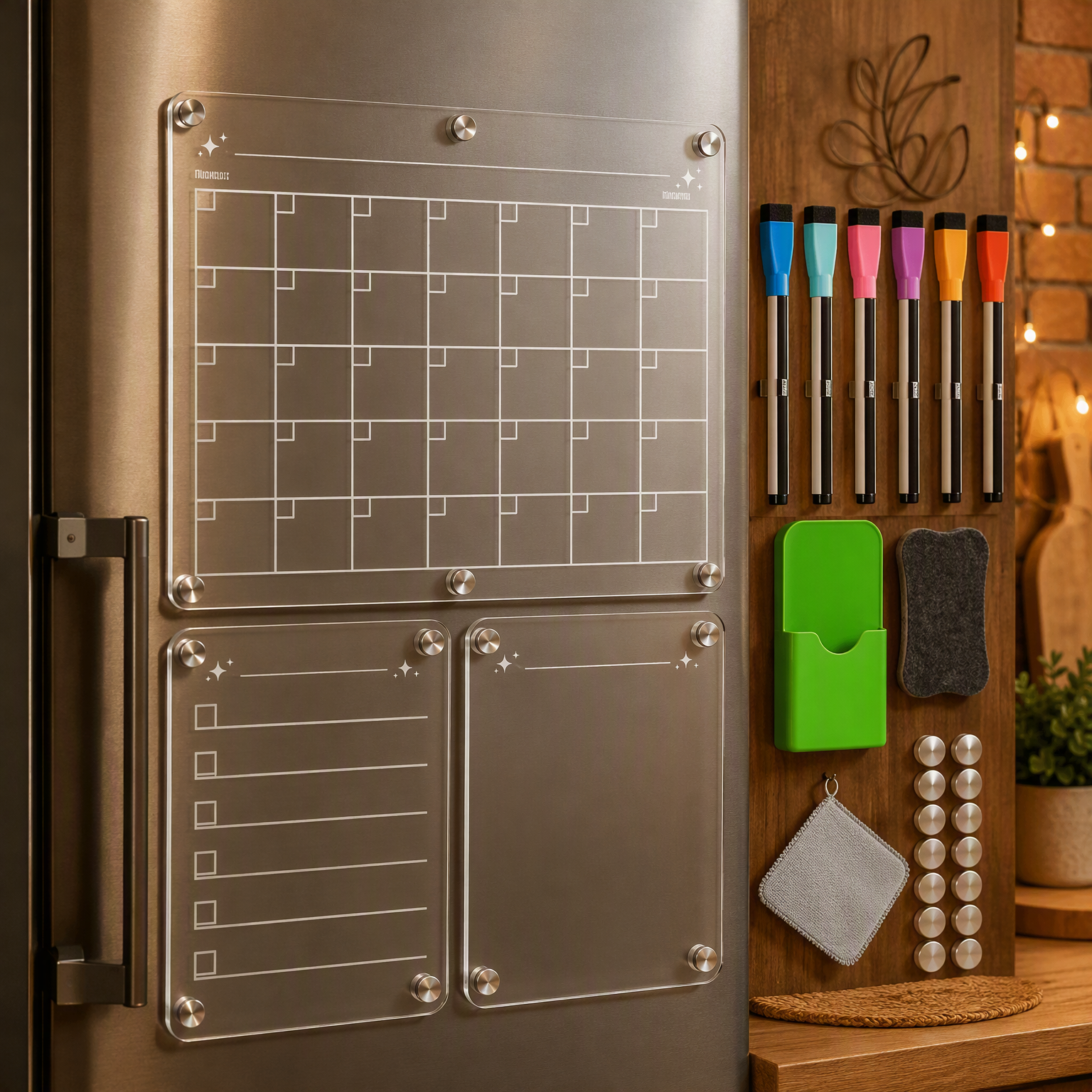
A dry erase board magnetic surface is more than a writing area: it is a reusable planning, teaching, and display tool. A good board lets people write and erase, then hold schedules, lesson cards, notices, drawings, or samples in place with magnets. That combination makes a dry erase board magnetic system useful in a kitchen, a meeting room, a classroom, or a retail display. The most suitable choice depends on how often it will be written on, what must be displayed, where it will be mounted, and how consistently it must perform across a larger order.
For institutional and resale buyers, start with the actual workflow rather than the largest panel or lowest quote. A compact mini whiteboard serves a very different task from a wall board for daily lessons or a mobile whiteboard with stand. This guide turns those differences into a practical purchasing checklist.
At home, a magnetic board can turn a refrigerator, entryway, or study corner into a visible family calendar and message station. A small dry erase board magnetic format is particularly useful when notes need to change every day without creating paper clutter. For home users, the priority is usually compact size, an easy-clean surface, safe mounting, and a layout that fits the available wall or appliance space.
In offices, the same board becomes a meeting tool. Teams use magnetic white boards for sprint planning, production status, visitor notices, and brainstorming. A fixed wall panel suits a stable collaboration zone, while a whiteboard with stand can move between training rooms and open workspaces. Before ordering, check viewing distance, lighting, wall construction, and whether staff will pin multiple sheets at once. Magnets holding a single page may behave differently from magnets holding layered handouts.
Education settings often demand the broadest mix of uses: a teacher writes, pupils attach letters or number cards, and administrators replace notices. For this reason, a classroom dry erase board magnetic surface should be evaluated for readable viewing, clean erasure, magnetic response, edge finishing, and a size that leaves room for doors, displays, and safe circulation. A mini whiteboard can support individual practice; a larger panel supports shared instruction.
Surface construction has a direct effect on writing feel, cleanability, glare, magnetic performance, and long-term appearance. Three common options are painted steel, porcelain enamel on steel, and glass. No surface suits every use case; match it to frequency of use and maintenance expectations.
| Surface | Where it fits | What to verify |
|---|---|---|
| Painted steel | General office, home, light-to-moderate classroom use | Coating quality, flatness, erasing after normal marker use, and magnet hold |
| Porcelain enamel on steel | High-use teaching and busy shared spaces | Steel backing, enamel finish, edge protection, mounting plan, and sample erasure |
| Glass | Design-led offices and premium presentation spaces | Whether the construction is magnetic, appropriate magnet strength, weight, and wall fixing |
Painted steel is a familiar starting point for a dry erase board magnetic order because steel can provide the receptive layer for magnets while the finish provides the write-and-wipe surface. It can be sensible for routine planning and display work, provided the coating and backing are appropriate for the intended frequency of use. Ask for a representative sample, write on it with the marker type your users expect to buy, and erase it after a realistic dwell time.
Porcelain enamel on steel is often considered when the board will see heavy, repeated use. Its non-porous enamel surface is commonly selected for strong resistance to staining and ghosting, while the steel base supports magnets. It can be a better fit for high-traffic schools or operations rooms, but buyers should still confirm the actual construction rather than treating a material label as a complete specification.
Glass offers a clean, modern appearance and can be easy to wipe, but it requires more careful questions. Not every glass board is magnetic, and magnetic glass constructions may need stronger magnets because the glass creates separation from the steel layer. Consider glare from windows or ceiling lights, mounting load, and whether the visual style is worth the different installation requirements. A dry erase board magnetic glass option is most convincing when its magnetic function has been demonstrated with the accessories users will actually handle.

Use a sample-based checklist. First, inspect surface flatness from several angles under normal room lighting. Then write, erase, and repeat with a compatible dry erase marker. Check the corners, frame joints, tray or accessory fit, and mounting hardware. Test magnets with the paper stack, card, or teaching aid that will be displayed. Finally, confirm packaging protection if the shipment will pass through a distribution network.
For a batch purchase, consistency matters as much as a good individual sample. Standardize the surface, frame color, dimensions, print artwork, packaging, and accessory set in the approved specification. This is especially important for retailers, school projects, and multi-office installations. A low unit price can stop being economical if mixed dimensions or finish variations complicate installation and later replacement.
OEM/ODM capability is valuable when the board must fit an existing program rather than a catalog dimension. Shenzhen U&U Magnetic Technology Co., Ltd. (UNU) manufactures OEM/ODM magnetic whiteboards and related magnetic products, with no stated MOQ in its merchant profile. For a custom dry erase board magnetic project, define the finished dimensions, writing surface, backing, frame, printed layout, hanging method, packaging, and target market before sampling. If the design includes a planner, calendar, branded grid, or educational artwork, approve the artwork and a physical or production-representative sample before scale-up.
UNU’s confirmed company profile also lists ISO9001, CE, and ROHS certification. Buyers should request the documentation relevant to their destination market and specific product configuration; a company-level profile is not a substitute for verifying the documents required for each order. For product starting points, see UNU’s customizable magnetic drywipe whiteboard, magnetic dry erase fridge calendar board, and customizable magnetic culture wall whiteboard. These links identify available catalog references only; confirm final specifications directly for the order.
There is no reliable single price range for every dry erase board magnetic purchase because size, surface, frame, print, packing, order volume, freight, and installation all change the landed cost. Instead of comparing quotes only by unit price, ask suppliers to separate the cost drivers. A basic small painted-steel board, a mobile whiteboard with stand, a porcelain-enamel classroom installation, and a magnetic glass board should not be priced as interchangeable products.
For a meaningful comparison, request like-for-like quotations with the same dimensions, surface construction, packaging, accessories, artwork, Incoterm, and quality-control expectation. Then compare sample cost, tooling or print setup where applicable, unit price at the planned quantity, spare-part availability, and replacement process. This protects buyers from an attractive opening quote that excludes the details needed for a usable finished program.
Routine care is straightforward, but it matters. Erase fresh writing with a clean, board-appropriate eraser or soft cloth. For residue, use a cleaner approved for the board surface and follow its instructions; avoid abrasive pads, harsh scouring powders, and sharp tools. Test any cleaning method on a small inconspicuous area first, particularly on printed boards or specialized coatings. Do not leave marker ink on a dry erase board magnetic surface longer than necessary, and keep magnets clean so grit does not scratch the finish.
Recheck the mounting periodically, especially for a moving whiteboard with stand or a heavy glass installation. Train users to use compatible dry erase markers rather than permanent markers. These ordinary habits help preserve eraseability and appearance across the board’s working life.
A well-chosen dry erase board magnetic solution combines the right surface, format, and supplier controls for its actual environment. When buyers test the details early, they can choose among magnetic white boards, mobile formats, and compact boards with far more confidence.

2026/08/20
Unlock flexible, repositionable whiteboarding for education, agile offices, retail, healthcare & more. Cuttable, magnetic, certified — request your free B2B sample today.

2026/10/10
Discover the 2027 Texture Magnetic Collection & Exclusive Exhibition Promotions Dear Global Partners and Valued Clients, We are thrilled to announce that Shenzhen U&U Magnetic Technology Co., Ltd. (Brand: UCMD) will be officially exhibiting...

2026/08/19
Discover how UCMD® leverages the Canton Fair to showcase magnetic educational & lifestyle products, build global buyer trust, and drive OEM/ODM partnerships. Explore our certified, customizable solutions today.

2026/08/28
Our Commitment to People, Planet & IntegrityAt ShenZhen U&U Magnetic Technology Co., Ltd. (UCMD®), we believe that how we make our products matters as much as what we make. From our factory floor in Shenzhen's Bao An District to the hands...

Please tell us about your company's advantages and characteristics.

Please tell us about your company's advantages and characteristics.

Please tell us about your company's advantages and characteristics.

Please tell us about your company's advantages and characteristics.

Please tell us about your company's advantages and characteristics.

Please tell us about your company's advantages and characteristics.

