 EN

Magnetic Whiteboards for Offices
Please tell us about your company's advantages and characteristics.
2026/10/12

A flexible rubber magnet looks simple until a project asks it to bend around a curve, hold a label in place, or survive repeated handling. Unlike rigid magnets, flexible magnetic rubber is normally supplied as a strip, sheet, or roll that can be slit, die-cut, punched, laminated, or paired with an adhesive. That makes it useful for photo crafts and removable displays, but it also gives fabricators a practical material for positioning, closures, and light-duty industrial tasks.
The key is to choose a flexible rubber magnet by the job rather than by thickness alone. Magnetic performance changes with material grade, thickness, contact area, the steel surface, and anything between the magnet and that surface. A sample test on the real substrate is more reliable than a generic pull-force promise.
A flexible rubber magnet is a composite magnetic material: magnetic powder is blended into a flexible binder, formed into a sheet or strip, and magnetized. Many products have a multipole magnetic face, which concentrates attraction on the working side. The opposite face may be plain, printable, foam-laminated, or pressure-sensitive adhesive-backed.
This construction explains why a flexible rubber magnet can be rolled for storage, trimmed for a display, or applied to a flat steel surface. It also explains a useful limitation: it is not a substitute for a small high-strength permanent magnet where a compact, high-load hold is required.
For crafters, a flexible rubber magnet turns lightweight artwork into a removable fridge or locker display. A thin adhesive-backed strip can be cut to match the back of a card, a child’s drawing, or a light photo board. It is especially handy when people make your own photo magnets: use enough contact area to keep a print flat, keep the backing away from the image edge, and test the finished piece on the intended appliance.
Large photo magnets need more than a small square at each corner. A wider strip or several evenly spaced pieces helps prevent curling and distributes support across the photo board. For a decorative piece, clean the steel surface first; dust, protective films, and textured finishes can reduce real-world contact.
A flexible rubber magnet also suits removable labels, rotating notices, and sports schedule magnets. Teams, schools, and local businesses can print or laminate an updateable schedule panel, then use magnetic backing so it can move between a refrigerator, filing cabinet, or steel display surface. This is a low-commitment format: the schedule can be replaced without drilling holes or permanently marking the surface.
For a practical ready-made display reference, a removable magnetic bulletin board shows the broader value of repositionable magnetic presentation. Confirm the receiving surface is magnetic before specifying any magnetic product.
In workshops and light industrial settings, flexible magnetic strip is often chosen for removable rack labels, steel-door reminders, temporary positioning aids, cabinet closures, and replaceable signage. It can also appear in magnetic sealing or closure concepts where the design calls for a broad, conforming contact line rather than a rigid part. The final suitability depends on temperature, chemical exposure, flexing cycles, surface geometry, and the required holding margin.
Do not treat “thicker” as the whole specification. A thicker flexible rubber magnet may provide more magnetic material, yet an uneven or painted steel surface can still reduce the practical hold. Specify the application, mating surface, required bend radius, and test method alongside the thickness.
Flexible magnetic materials are commonly offered in a broad range that includes roughly 0.3 mm to 5 mm. The right point in that range is a balance among flexibility, cost, handling, and the safety margin needed for the item being held.
| Typical range | Useful starting point | Questions to verify |
|---|---|---|
| 0.3–0.8 mm | Light paper crafts, thin photo pieces, lightweight labels | Will the piece stay flat, and is the steel surface smooth? |
| About 1–2 mm | Reusable signs, schedule cards, thicker laminated craft pieces | Is the strip wide enough for the contact area needed? |
| Above 2 mm up to 5 mm | More robust fabricated components and applications needing less flex | Can the part still bend to the required radius, and has it passed an application test? |
These are selection prompts, not load ratings. Grade and magnetization, the amount of steel available, and a possible air gap all matter. When a project affects safety, transport, or a critical seal, use an engineered design and validate it under the actual operating conditions.
Wholesalers, makers, and OEM buyers can reduce avoidable rework by writing the brief around use conditions. State the required width and length, thickness range, roll core preference, magnetized face, plain or adhesive backing, cut tolerance, intended steel surface, artwork or laminate requirements, and packaging count. If the material will become a kit component, include the target bend, storage temperature, and handling steps.
For related magnetic learning and display merchandise, the site also carries a magnetic tangram set. It is a product example rather than evidence for strip performance; magnetic rubber specifications should be confirmed separately.
A flexible rubber magnet is most useful when its flexibility and broad contact area solve a real handling problem. Start with the surface, the item weight and shape, and the required service conditions. Then compare thickness, grade, width, backing, and conversion method through samples. That process gives craft buyers a cleaner DIY result and gives industrial purchasers a specification they can test, repeat, and scale.

2026/08/20
Unlock flexible, repositionable whiteboarding for education, agile offices, retail, healthcare & more. Cuttable, magnetic, certified — request your free B2B sample today.

2026/10/10
Discover the 2027 Texture Magnetic Collection & Exclusive Exhibition Promotions Dear Global Partners and Valued Clients, We are thrilled to announce that Shenzhen U&U Magnetic Technology Co., Ltd. (Brand: UCMD) will be officially exhibiting...
2026/08/19
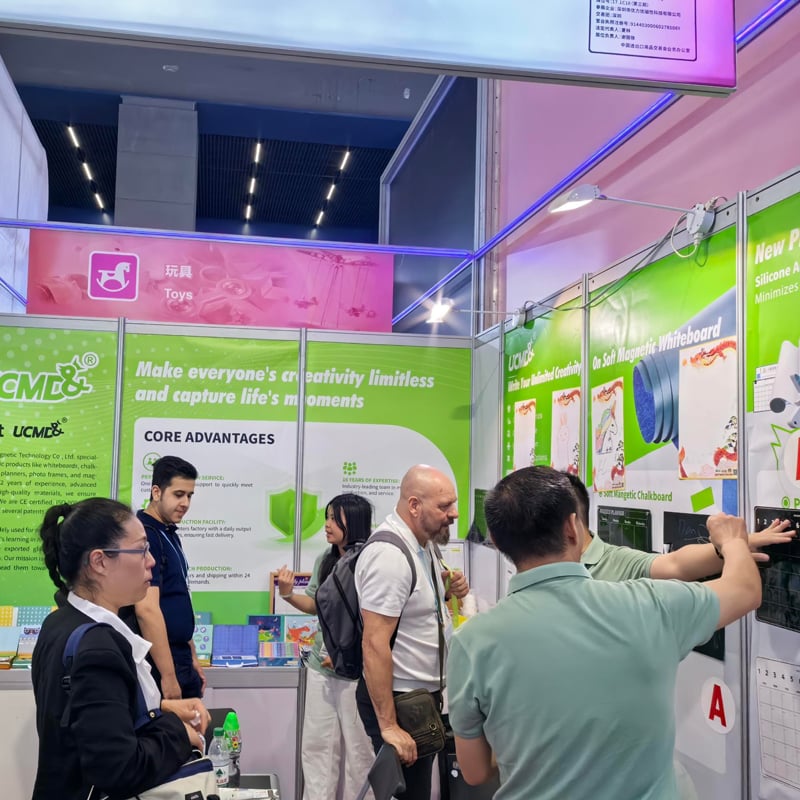
Discover how UCMD® leverages the Canton Fair to showcase magnetic educational & lifestyle products, build global buyer trust, and drive OEM/ODM partnerships. Explore our certified, customizable solutions today.

2026/08/28
Our Commitment to People, Planet & IntegrityAt ShenZhen U&U Magnetic Technology Co., Ltd. (UCMD®), we believe that how we make our products matters as much as what we make. From our factory floor in Shenzhen's Bao An District to the hands...

Please tell us about your company's advantages and characteristics.

Please tell us about your company's advantages and characteristics.

Please tell us about your company's advantages and characteristics.

Please tell us about your company's advantages and characteristics.

Please tell us about your company's advantages and characteristics.

Please tell us about your company's advantages and characteristics.

