 EN

Magnetic Whiteboards for Offices
Please tell us about your company's advantages and characteristics.
2026/09/30
A dry erase board with stand earns its place when the writing surface has to move with the work. A fixed wall board is excellent for a permanent planning area, but an office that rearranges meeting rooms, a teacher who shares spaces, or a training team that travels between sites needs a board that can be rolled, carried, stored, and set up again without becoming a distraction. A sound choice is not simply the largest panel. It is the right balance of surface, frame, stand, and handling for the people who will use it.
As a magnetic-products adviser, I start with the use pattern rather than a catalog photo. Ask where the board will live on ordinary days, who moves it, how often it is erased, and whether it must also hold paper with magnets. Those answers make the portable options much easier to compare.
“Freestanding” covers several designs. An easel is usually the lightest choice for short presentations and workshops. A mobile board on locking casters is better when teams move it between rooms. A folding whiteboard usually refers to a model whose legs or frame collapse for storage or transport. A foldable whiteboard may describe a folding frame, a hinged panel, or both, so buyers should confirm exactly what folds before comparing quotes.
Do not treat portability as a vague feature. Request the folded footprint, overall height, wheel-lock arrangement where applicable, and whether one person can safely reposition the unit. A larger board can be more useful in a group session, yet it loses that advantage if its stand flexes or it will not pass through the doors it must use.
For a dry erase board with stand, the stand may determine mobility, but the surface determines whether daily writing remains pleasant. Painted steel, porcelain-on-steel, and glass are commonly considered different dry-erase surface categories. Each can be the right answer in a different setting.
| Surface | Best-fit use pattern | What to check |
|---|---|---|
| Painted steel | General office planning, meetings, and moderate classroom use | Magnetic capability, frame rigidity, and cleaning guidance |
| Porcelain-on-steel | High-frequency shared writing areas | Budget, weight, mounting to the stand, and the supplier’s surface specification |
| Glass | Design-led offices and spaces where scratch and dent resistance matter | Weight, edge treatment, stand stability, and marker visibility |
Porcelain-on-steel is often associated with heavy-duty, repeatedly erased applications, while glass is valued for a smooth, durable writing surface. Neither statement removes the need to examine the whole unit. A premium panel on an undersized base can still be the wrong portable purchase. Conversely, a modest painted-steel board can perform well for a team that writes only during weekly meetings and stores it carefully.
In a home command center, a mobile board may complement a big whiteboard calendar for wall rather than replace it. Keep the fixed calendar for recurring family deadlines and use the freestanding board for weekly meal planning, project brainstorming, or children’s homework reminders. That division prevents the calendar from becoming a crowded scratchpad.
In offices, choose a board width that lets several people contribute without standing shoulder to shoulder. A marker tray, a magnetic surface, and locked casters are often more useful than decorative extras. For classrooms, think about sightlines and whether students will interact with both sides. A double-sided dry erase board with stand can create two working zones, but only if the base is stable enough for regular turns and repositioning.
For buyers sourcing a broader magnetic-board range, the confirmed product catalog includes a customizable magnetic culture wall whiteboard. It is a relevant reference for teams considering custom printed communication surfaces alongside portable formats. The catalog also includes a customizable magnetic drywipe whiteboard for buyers reviewing magnetic whiteboard options.
Custom dimensions and printed layouts can make a dry erase board with stand much more useful. A school may need ruled areas for lesson routines; a sales team may want a reusable pipeline grid; a distributor may need private-label packaging. OEM and custom-printing discussions should state the intended board format, surface, artwork, packaging, and expected order requirements. This avoids a common problem: approving a panel design without specifying how the frame and stand will support it.
Customization cannot compensate for an unclear application. If a board will be carried to events every week, prioritize transport and setup. If it will remain in a shared training room, prioritize stability and an easy-clean surface. Buyers looking for children’s planning formats can also review the confirmed kids’ dry-erase magnetic to-do and reward chart as a separate, purpose-specific planning tool.
Good maintenance is simple: erase promptly after long sessions, use cleaners recommended for the specific surface, and avoid abrasive tools that can leave residue or damage finishes. Test unfamiliar cleaning products in a small area first. Store a folding whiteboard dry and closed according to its handling instructions, and periodically check wheel locks, hinges, and fasteners. If ghosting appears, review marker quality and cleaning practice before assuming the board itself has failed.
The most suitable portable option is the one people will confidently move, write on, and reset for the next session. For most procurement decisions, rank requirements in this order: intended use, required writing area, surface and magnetic function, stand stability, movement and storage, then customization. That process keeps a dry erase board with stand from becoming an underused piece of furniture and turns it into a flexible working surface for home, office, or education settings.

2026/08/20
Unlock flexible, repositionable whiteboarding for education, agile offices, retail, healthcare & more. Cuttable, magnetic, certified — request your free B2B sample today.

2026/10/10
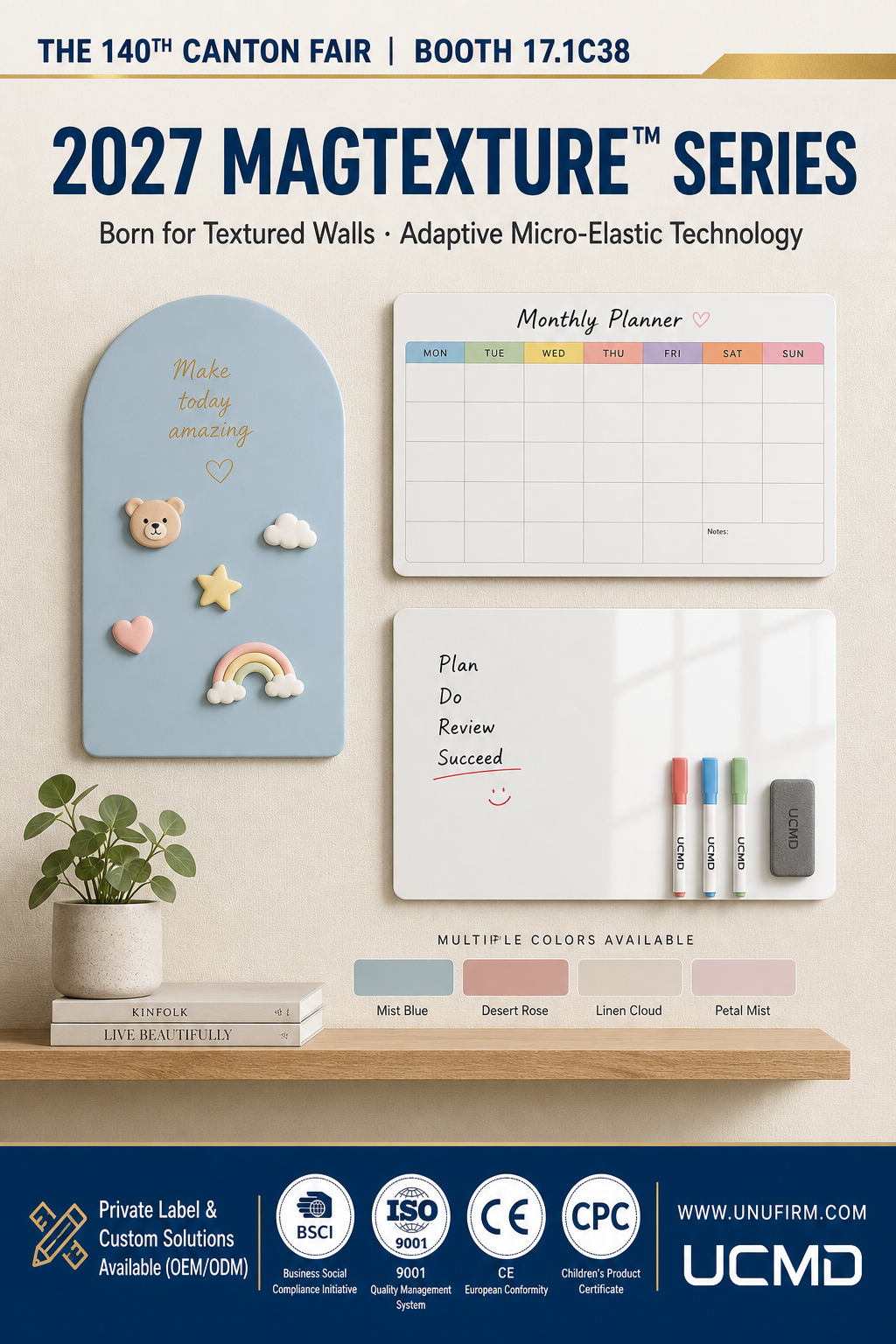
Discover the 2027 Texture Magnetic Collection & Exclusive Exhibition Promotions Dear Global Partners and Valued Clients, We are thrilled to announce that Shenzhen U&U Magnetic Technology Co., Ltd. (Brand: UCMD) will be officially exhibiting...

2026/08/19
Discover how UCMD® leverages the Canton Fair to showcase magnetic educational & lifestyle products, build global buyer trust, and drive OEM/ODM partnerships. Explore our certified, customizable solutions today.

2026/08/28
Our Commitment to People, Planet & IntegrityAt ShenZhen U&U Magnetic Technology Co., Ltd. (UCMD®), we believe that how we make our products matters as much as what we make. From our factory floor in Shenzhen's Bao An District to the hands...

Please tell us about your company's advantages and characteristics.

Please tell us about your company's advantages and characteristics.

Please tell us about your company's advantages and characteristics.

Please tell us about your company's advantages and characteristics.

Please tell us about your company's advantages and characteristics.

Please tell us about your company's advantages and characteristics.

