 EN

Magnetic Whiteboards for Offices
Please tell us about your company's advantages and characteristics.
2026/09/14
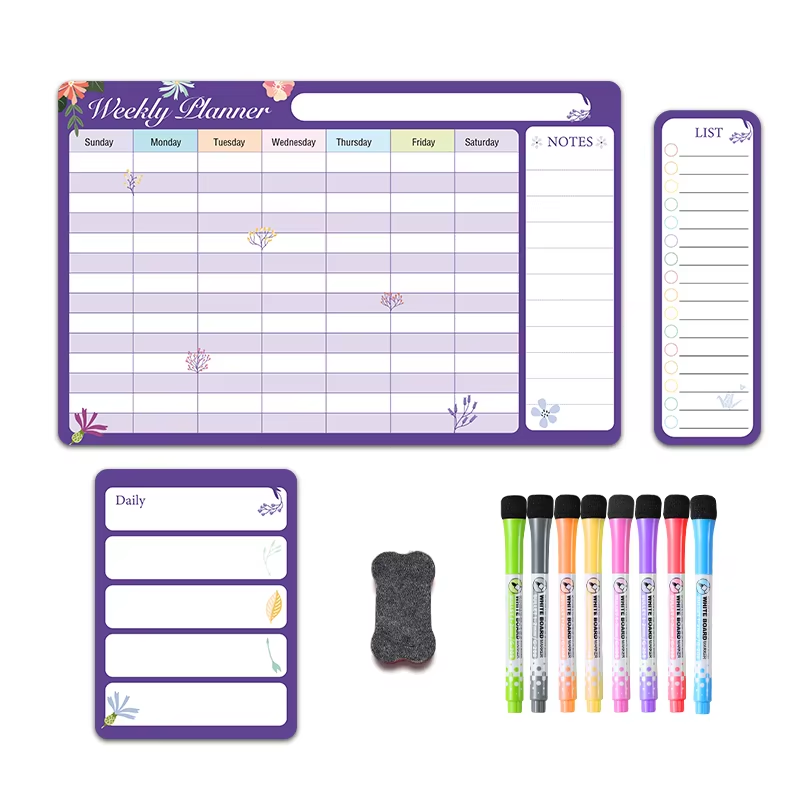
Effective time management begins with selecting the right organizational medium for professional and personal tasks. Many individuals struggle between traditional paper notebooks and modern display boards when trying to map out their weekly responsibilities. A paper-based system offers portable note-taking, whereas visual wall or refrigerator displays provide constant reminders for shared environments. Evaluating personal habits, family coordination needs, and workspace dynamics helps determine whether a bound diary or a surface-mounted tool serves better. Industry experts note that matching the physical format of a planner to natural workflow habits significantly increases long-term consistency and reduces missed deadlines. Professionals balancing multiple projects often look closely at options like a hobonichi weekly planner for portable scheduling, while families or busy office teams lean toward alternative display solutions. Selecting an appropriate organizational tool requires a clear understanding of how daily tasks are tracked, reviewed, and executed across different settings.
The hobonichi weekly planner has gained a widespread following among stationery enthusiasts and busy professionals due to its distinctive layout and lightweight paper quality. Designed to provide a weekly overview alongside dedicated grid space for notes, this portable planner allows users to document appointments, priorities, and daily tasks within a compact format. The integration of specialized lightweight paper ensures that the book remains thin despite containing months of planning pages. Users often appreciate the balance between structured calendar grids and open writing areas, which accommodates both rigid scheduling and freeform journaling. However, relying entirely on a bound notebook means that plans remain hidden unless the book is opened and placed on a desk. This limitation prompts many users to seek complementary visual tools, especially when household members or office colleagues need instant visibility into shared weekly schedules without opening a personal diary.
When daily coordination involves multiple family members or fast-paced office environments, stationary visual boards offer distinct advantages over pocket-sized books. A magnetic weekly planner provides a centralized surface mounted on a refrigerator, office wall, or classroom whiteboard, allowing everyone in the space to view upcoming tasks at a glance. Unlike traditional notebooks that require active consultation, a magnetic dry-erase display acts as a passive reminder system that minimizes miscommunication and keeps team priorities visible. Users can easily update schedules, shift appointments, or rewrite weekly goals using dry-erase markers without cluttering pages. This visual accessibility makes surface planners exceptionally practical for managing grocery lists, chore rotations, and team project timelines. Incorporating this type of display alongside portable notebooks creates a balanced organizational ecosystem where high-level overviews remain public while detailed personal notes stay private.
For organizations and households seeking durable and practical visual display tools, UNU offers specialized accessories designed for efficient scheduling. The UNU planner lineup includes versatile magnetic board options engineered for refrigerator attachment, office collaboration spaces, and classroom environments. These dry-erase weekly and monthly whiteboards provide smooth writing surfaces that wipe clean easily, ensuring long-term usability without ghosting or staining. When comparing portable bound notebooks with structured display boards, products from UNU bridge the gap between shared visibility and personal task coordination. Facility managers and household organizers find that deploying a reliable refrigerator calendar eliminates the friction of verbal reminders and centralizes family or team activities into one accessible location. By utilizing these physical planning boards, users establish a transparent routine that supports seamless operational flow and reduces daily oversight errors.
Choosing between a portable bound diary and a surface-mounted tracking board ultimately depends on individual daily routines and spatial requirements. Individuals who travel frequently, attend numerous off-site meetings, or prefer private handwritten logs benefit greatly from compact, portable systems. Conversely, busy households, collaborative office bullpens, and shared workspaces thrive when utilizing a central UNU planner displayed prominently on a metallic surface or refrigerator door. Many successful organizers adopt a hybrid strategy, utilizing a pocket diary for mobile appointments while maintaining a central refrigerator whiteboard for family or team milestones. Reviewing workspace constraints, mobility needs, and the number of individuals involved in daily scheduling ensures an optimal selection. By aligning organizational choices with practical daily realities, users cultivate sustainable habits that enhance productivity and reduce scheduling stress over the long term.
Integrating both portable notebooks and stationary display boards creates a comprehensive workflow that addresses various planning requirements throughout the day. While a pocket-sized diary captures spontaneous ideas during transit, a centrally located dry-erase board ensures that long-term goals remain visible to everyone in the household or office. This multi-layered approach prevents important deadlines from slipping through the cracks and accommodates different cognitive processing styles. Productivity research indicates that combining tactile writing with visual environmental cues significantly improves task completion rates and mental clarity. By blending the structured tracking of a hobonichi weekly planner with the prominent display features of a UNU planner, users establish a robust system designed for sustained efficiency and seamless time management.

2026/08/20
Unlock flexible, repositionable whiteboarding for education, agile offices, retail, healthcare & more. Cuttable, magnetic, certified — request your free B2B sample today.

2026/10/10
Discover the 2027 Texture Magnetic Collection & Exclusive Exhibition Promotions Dear Global Partners and Valued Clients, We are thrilled to announce that Shenzhen U&U Magnetic Technology Co., Ltd. (Brand: UCMD) will be officially exhibiting...

2026/08/19
Discover how UCMD® leverages the Canton Fair to showcase magnetic educational & lifestyle products, build global buyer trust, and drive OEM/ODM partnerships. Explore our certified, customizable solutions today.

2026/08/28
Our Commitment to People, Planet & IntegrityAt ShenZhen U&U Magnetic Technology Co., Ltd. (UCMD®), we believe that how we make our products matters as much as what we make. From our factory floor in Shenzhen's Bao An District to the hands...

Please tell us about your company's advantages and characteristics.

Please tell us about your company's advantages and characteristics.

Please tell us about your company's advantages and characteristics.

Please tell us about your company's advantages and characteristics.

Please tell us about your company's advantages and characteristics.

Please tell us about your company's advantages and characteristics.

