 EN

Magnetic Whiteboards for Offices
Please tell us about your company's advantages and characteristics.
2026/10/02
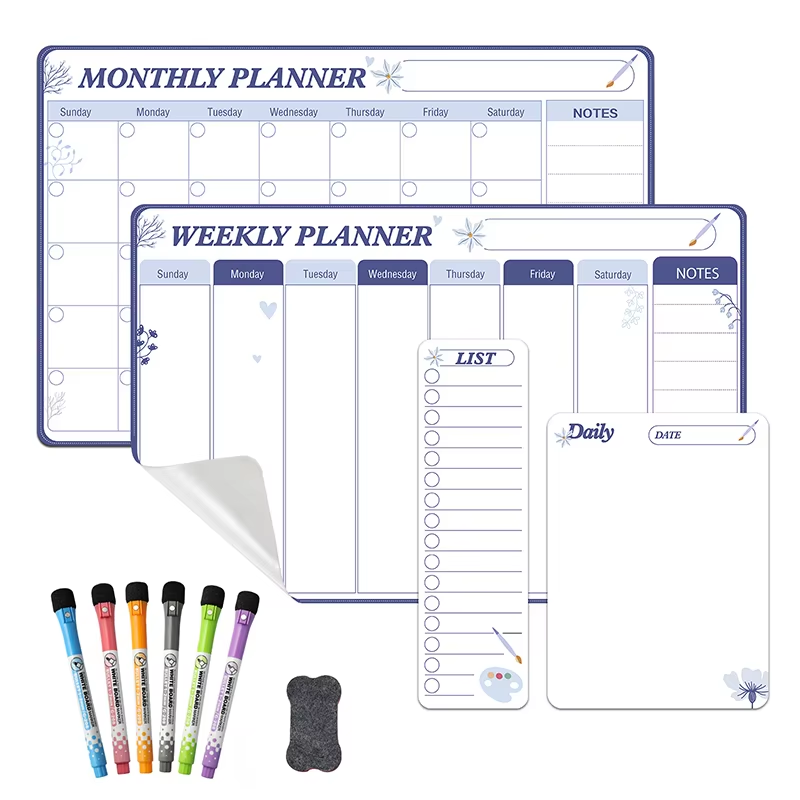
A large dry erase calendar is most useful when it changes behavior, not just décor. In a busy home, classroom, or office, a shared board makes deadlines, shifts, appointments, and handoffs visible before they are forgotten. The buying decision is less about finding the biggest rectangle and more about matching the planning surface to the people who will read, update, and maintain it.
For retail buyers, that means choosing an intuitive format that earns a place on the wall or refrigerator. For distributors and institutional purchasers, it also means controlling consistency, packaging, customization, and replacement planning. This guide uses that practical lens.
Digital calendars are excellent for reminders, recurring events, and private schedules. Paper calendars are simple and portable. A large dry erase calendar does something neither handles as naturally: it creates a glanceable, shared display in the place where coordination happens. A family can see school events beside meal plans; an office team can see a campaign rhythm without opening another app; a reception area can track appointments at a distance.
The advantage is not that a wall planner replaces every digital tool. It works well as the common visual layer. If the board is placed where people already pause, a quick update can prevent a missed handoff. That is especially valuable when several people contribute to the same schedule or when guests, children, or front-line staff do not all use the same software.
Start with the time horizon. A large dry erase calendar that has the wrong grid can be frustrating even when its surface is generous.
| Format | Best for | What to check |
|---|---|---|
| Monthly | Households, project milestones, school events, and appointment visibility | Enough writing room in each day; an undated layout can reduce leftover stock after a year changes. |
| Weekly | Shift handoffs, detailed assignments, meal plans, and time-sensitive work | Day columns, time blocks, and a notes area that matches the actual routine. |
| Year-at-a-glance | Seasonal campaigns, term dates, annual leave, and capacity planning | Legibility from the expected viewing distance; this format is usually a complement rather than the only planner. |
| Hybrid monthly + weekly | Users who need both commitments and near-term action lists | Whether the divided surface leaves enough usable room for both jobs. |
Do not assume larger is automatically better. Search results for oversized calendars include formats from 3×4 feet to 4×8 feet, but the relevant measure is the space available per day after headers, borders, and notes sections are removed. A very wide board can also become hard to read from side angles. Measure the usable wall area, viewing distance, and the longest typical entry before committing.
Paper is inexpensive and needs no setup, but revisions can become messy and annual replacement is built in. Digital calendars are searchable and portable, but they depend on individual device habits and can be invisible to people outside the account. A reusable magnetic or dry erase board gives the schedule a physical presence and lets users move notes, markers, and magnetic labels as plans change.
A large whiteboard for wall use can be a better fit than a preprinted calendar when teams need flexible zones for priorities, deadlines, and brainstorming. Conversely, a fixed calendar grid reduces the friction of deciding how to organize the surface. For a polished executive area, a magnetic glass whiteboard may be worth evaluating for appearance and cleanability, but purchasers should confirm magnet compatibility, mounting requirements, reflection under the actual lighting, and the marker type recommended for its surface.
Measure wall width and height, but also allow clearance for doors, cabinets, and the person writing on the board. In a kitchen, a compact magnetic refrigerator planner may be more useful than a large wall unit. In a shared office, the board should be readable from the normal standing or meeting position. If mounting is planned, verify wall construction and fixing method early rather than treating installation as an afterthought.
Ask for the grid dimensions, not only the overall product dimensions. Large day boxes suit households with multiple names or offices that need task ownership; smaller boxes may be enough for a yearly overview. Consider line contrast, header color, and glare. A board that looks striking under showroom lighting can be difficult to read under direct windows or overhead fixtures.
“Magnetic” can mean the board accepts magnets, has a magnetic backing for a metal surface, or both. Confirm which function is needed. For a fridge planner, backing strength and refrigerator compatibility matter. For a wall board, users may need magnets to hold printed notices alongside handwritten updates. A large dry erase calendar should also be tested with the intended marker and eraser, because stain resistance is a surface-and-maintenance question rather than a promise implied by the word “erasable.”
High-touch planning boards deserve an easy-care surface and a realistic cleaning routine. Erase writing promptly, use a clean soft cloth, and avoid abrasive or caustic cleaners that can damage the finish. For a procurement program, request a sample and test marker removal, glare, edge finishing, and packaging protection in the intended setting. A short pilot is often more informative than a catalog comparison.
Markers, erasers, magnetic labels, and mounting hardware influence the everyday experience. Set a clear policy for which accessories ship with the board and how replacements will be sourced. In a school or multi-site office, standardized board dimensions and accessory sets simplify training and replenishment.
Retailers should curate formats that match recognizable routines: family monthly planners, refrigerator sets, student schedules, and office weekly boards. Packaging should communicate the grid, usable size, included accessories, and mounting or magnetic-back requirements without overclaiming performance.
B2B purchasers should add a few operational checks: can the supplier hold a consistent print layout across a run, protect corners and surfaces during transport, provide approved samples, and document the agreed specification? If the product will be sold under a private label, discuss OEM or ODM options such as board size, calendar layout, language, logo placement, color, packaging, and accessory configuration. U&U Magnetic states that it supports OEM/ODM development for magnetic planners and related whiteboard products; buyers should still confirm the exact scope, artwork approval process, minimum order requirements, and timing for their project.
For buyers evaluating ready-made examples, the product catalog includes an A3 Size Dry Erase Calendar for Refrigerator Office Desktop Magnetic Calendar Board Desktop Monthly Planner Sheet, a Reusable Magnetic Fridge Calendar Monthly & Weekly Planner with Dry Erase Markers for Kitchen Organization, and a Weekly Planner Magnetic Board Dry Erase Monthly Planner Whiteboard for Fridge. Review each listing for the configuration relevant to your market rather than treating one format as universal.
The value of a large dry erase calendar comes from repeated use. Put it where the schedule needs to be seen, agree who updates it, and make cleaning part of the routine. Keep the language on the board short, use a consistent color convention, and clear outdated entries promptly. When the planning system fits the setting, a reusable board becomes a dependable shared reference rather than another surface that gathers old notes.

2026/08/20
Unlock flexible, repositionable whiteboarding for education, agile offices, retail, healthcare & more. Cuttable, magnetic, certified — request your free B2B sample today.

2026/10/10
Discover the 2027 Texture Magnetic Collection & Exclusive Exhibition Promotions Dear Global Partners and Valued Clients, We are thrilled to announce that Shenzhen U&U Magnetic Technology Co., Ltd. (Brand: UCMD) will be officially exhibiting...

2026/08/19
Discover how UCMD® leverages the Canton Fair to showcase magnetic educational & lifestyle products, build global buyer trust, and drive OEM/ODM partnerships. Explore our certified, customizable solutions today.

2026/08/28
Our Commitment to People, Planet & IntegrityAt ShenZhen U&U Magnetic Technology Co., Ltd. (UCMD®), we believe that how we make our products matters as much as what we make. From our factory floor in Shenzhen's Bao An District to the hands...

Please tell us about your company's advantages and characteristics.

Please tell us about your company's advantages and characteristics.

Please tell us about your company's advantages and characteristics.

Please tell us about your company's advantages and characteristics.

Please tell us about your company's advantages and characteristics.

Please tell us about your company's advantages and characteristics.

