 EN

Magnetic Whiteboards for Offices
Please tell us about your company's advantages and characteristics.
2026/09/29
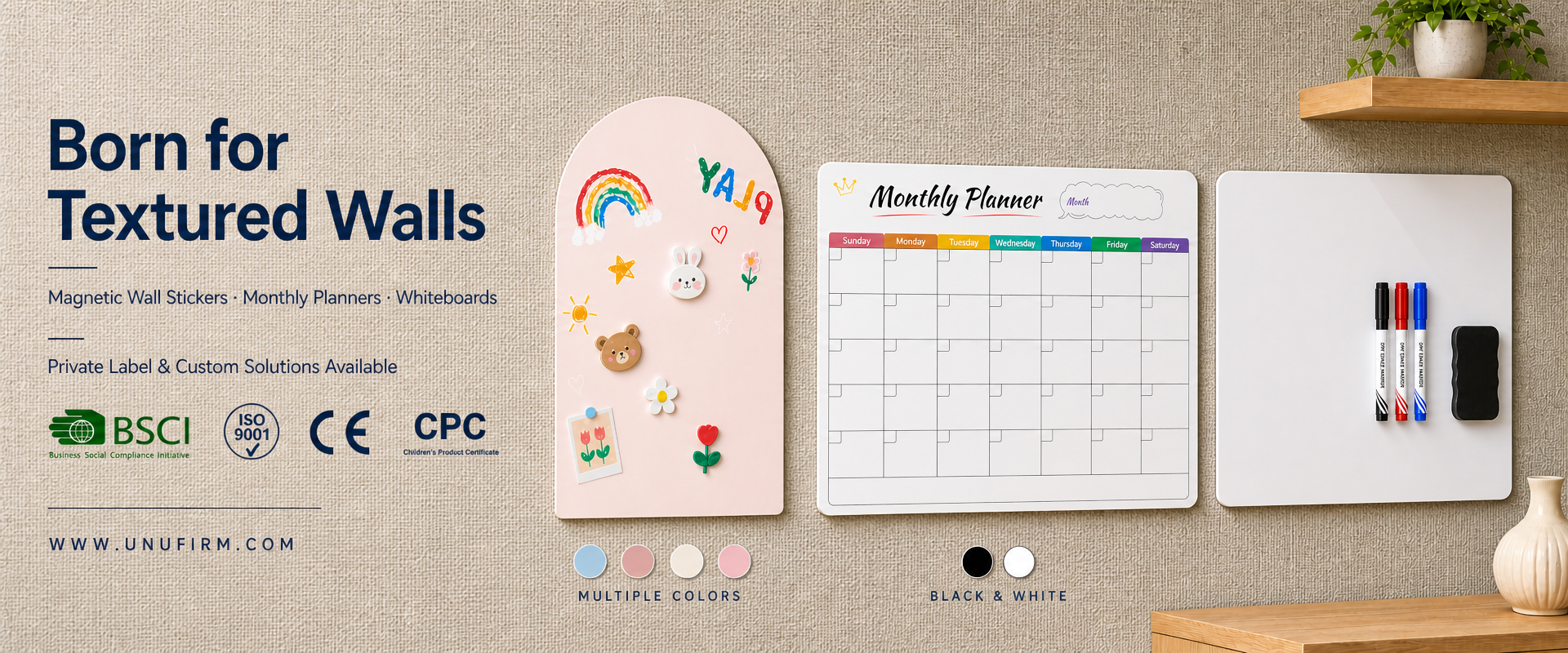
A large magnetic board earns its wall space when people need to see, move, and discuss information together. For a classroom, that may mean lesson materials and student work; for an office, it may mean a project plan that stays visible between meetings. The appropriate board is not automatically the biggest one. It is the surface whose usable writing area, viewing distance, wall condition, and mounting plan fit the job.
From a school procurement perspective, the decision starts with the room rather than a catalogue. A board that looks generous on a product page can overwhelm a narrow wall, while an undersized board can make a collaborative session feel cramped. This guide compares practical formats and gives buyers a repeatable way to specify the right surface before ordering.
Before choosing a board, list what must be visible at the same time. A single weekly schedule has a different footprint from a lesson sequence, a Kanban workflow, or a campaign wall with printouts and magnets. Leave room for headings, margins, and hands moving materials around; a board filled edge to edge quickly stops functioning as a shared workspace.
For a personal office or a compact teaching corner, a 24 x 36 white board can provide a useful landscape surface without dominating the room. Turned portrait-style, a 36x24 whiteboard may suit a narrow wall, a daily briefing, or a vertically arranged schedule. These are familiar starting sizes, not universal prescriptions: usable space changes with frames, trays, and the amount of material being displayed.
A 4x6 dry erase board is a different class of planning surface. Its larger footprint gives teams room for multiple workstreams or a teacher room for persistent reference material plus an active lesson area. Choose a board in this range when several people must read it from across the room, not merely stand beside it.
Use a simple wall-measurement check before requesting a quote for a board. Measure the clear width and height where the board will sit, then note doors, windows, outlets, switches, cabinetry, and furniture movement. Mark the proposed rectangle with painter’s tape if possible. It reveals whether a large magnetic board blocks circulation or leaves too little edge clearance for installation.
| Use case | Practical starting point | What to confirm |
|---|---|---|
| Small team room or tutoring space | 24 x 36 white board or 36x24 whiteboard | Whether landscape or portrait better follows the wall and seating layout |
| Classroom teaching wall | 4x6 dry erase board or a custom large magnetic board | Student sight lines, teaching zones, and access at the lower edge |
| Project room or shared planning wall | Large magnetic board with multi-column layout | Space for cards, legends, and people standing in front of the board |
| Reception or culture display | Custom large magnetic board | Viewing distance, wall finish, and change-out method for notices |
It is tempting to maximize every inch of wall, but that is not invariably the useful choice. If the board is mounted too high, shorter users lose the lower rows; too low, it can conflict with desks or cleaning access. The installed board should support the people who update it most often, with its final height confirmed against the room layout.
The 24 x 36 white board is often a sensible choice when content changes frequently but remains limited to one facilitator or small group. A 36x24 whiteboard offers nearly the same area in another orientation, which can be useful when the available wall is tall rather than wide. Neither replaces a 4x6 dry erase board when the aim is full-room collaboration.
For a board above standard formats, specify the working layout before specifying the outside dimensions. For example, divide the surface into monthly planning, active work, and reference zones. This turns a vague request for “large” into a practical brief. If the board is primarily for magnets, confirm the magnetic surface and the kind of items it must retain with the supplier rather than assuming every white surface performs the same way.
For buyers comparing ready-made and custom options, the Magnetic Culture Wall Whiteboard is one confirmed product-page option to review alongside the room plan. The point is not to select a model from its title alone; it is to use the product link as a starting place for confirming the available dimensions, surface, and mounting details.

A large wall-mounted board needs more than a clear wall. Record the wall construction, locate suitable fixing points, and ask the installer or supplier for the mounting method required for the final board. Do not infer load capacity from a photo or assume fasteners for drywall are appropriate for masonry, metal studs, or partitions. Large formats can also be awkward to turn through corridors, elevators, and doorways.
Build a delivery plan around the largest packaged piece, not only the board’s finished dimensions. Confirm who receives the shipment, where it can be staged, whether protective packaging can be removed safely, and how many people are needed to lift and align it. These practical steps reduce the chance that the board arrives on time but cannot be installed that day.
For schools, offices, and distributors, the visible board price is only one input. A bulk request should separate size, board construction, frame or edge treatment, printing or customization, packing, shipping, and installation preparation. That makes quotations easier to compare without pretending that one format is invariably cheaper.
Low unit price can be misleading if a specification forces rework after delivery. A buyer may initially focus only on the lowest-price board, then discover the planned wall, hole positions, or room layout does not match. A better approach is to share a dimensioned wall sketch, intended use, quantity, delivery constraints, and any branding requirement before seeking a batch quote. Suppliers that cover magnetic boards and related display products can help consolidate a multi-room request, but every order should still confirm the final specification in writing.
A well-chosen magnetic planning surface becomes a working surface rather than another piece of wall décor. Start with the activity, validate the wall and access conditions, then select the format that gives people enough visible space to collaborate comfortably.

2026/08/20
Unlock flexible, repositionable whiteboarding for education, agile offices, retail, healthcare & more. Cuttable, magnetic, certified — request your free B2B sample today.

2026/10/10
Discover the 2027 Texture Magnetic Collection & Exclusive Exhibition Promotions Dear Global Partners and Valued Clients, We are thrilled to announce that Shenzhen U&U Magnetic Technology Co., Ltd. (Brand: UCMD) will be officially exhibiting...

2026/08/19
Discover how UCMD® leverages the Canton Fair to showcase magnetic educational & lifestyle products, build global buyer trust, and drive OEM/ODM partnerships. Explore our certified, customizable solutions today.

2026/08/28
Our Commitment to People, Planet & IntegrityAt ShenZhen U&U Magnetic Technology Co., Ltd. (UCMD®), we believe that how we make our products matters as much as what we make. From our factory floor in Shenzhen's Bao An District to the hands...

Please tell us about your company's advantages and characteristics.

Please tell us about your company's advantages and characteristics.

Please tell us about your company's advantages and characteristics.

Please tell us about your company's advantages and characteristics.

Please tell us about your company's advantages and characteristics.

Please tell us about your company's advantages and characteristics.

