 EN

Magnetic Whiteboards for Offices
Please tell us about your company's advantages and characteristics.
2026/09/29
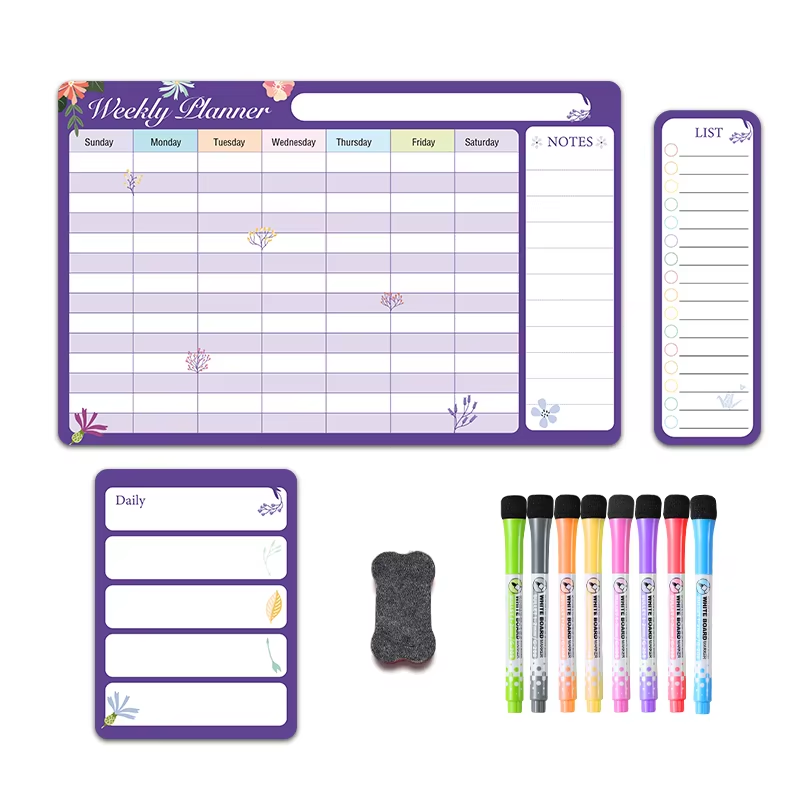
A magnetic whiteboard marker looks like a small accessory, but it affects whether a planning board stays useful between meetings, lessons, or family routines. The practical question is not simply whether a marker sticks to metal. A buyer needs a magnetic whiteboard marker whose tip, ink, cap, and attachment method suit the board surface and the people using it. As a magnetic-materials adviser, I would start with the daily workflow: who writes, how often content changes, and where the marker needs to live when the session ends.
That distinction matters for a home calendar, a classroom, and a shared office. A magnetic whiteboard marker can reduce misplaced supplies, yet the right choice also depends on the board behind it. Before comparing colors or pack sizes, confirm that the marker is intended for dry-erase surfaces and that the board itself has a magnetic receiving surface.
For a refrigerator calendar or weekly schedule planner, a fine or bullet tip often makes recurring appointments, shopping notes, and small boxes easier to read. A magnetic whiteboard marker with a built-in eraser may be convenient for quick corrections, although a separate eraser is usually easier to replace in a busy household. For a weekly schedule maker, choose colors that remain distinct at the distance where the schedule is read; test them on the actual board rather than judging from a catalog image.
In meeting rooms, the priority shifts toward line visibility, erasability, and keeping a set together. A chisel tip gives both broad headings and narrower labels when rotated, while a bullet tip is more predictable for lists. In classrooms, low-odor ink and clear product documentation may be more important procurement questions. “Low odor” describes an ink characteristic; if safety documentation is important to your institution, request the relevant product-specific documentation rather than treating a general label as proof of compliance.
For a mobile standing white board, check the marker’s magnet arrangement as well as its writing performance. Some marker caps or holders attach to a metal frame; others require a magnetic board surface. A magnetic whiteboard marker that falls from a moving board is not solving the storage problem.
| Format | Best fit | What to check |
|---|---|---|
| Marker with magnetic cap | Home calendars and light office use | Cap fit, magnet hold, and whether the cap can be misplaced |
| Marker with integrated eraser | Short notes and quick revisions | Eraser size, replaceability, and residue after repeated use |
| Marker set plus magnetic holder | Classrooms and shared teams | Holder capacity, board compatibility, and a consistent refill plan |
There is no universal winner. A marker with an integrated eraser is handy for a weekly schedule planner, but a holder-and-set approach may be better when several people use the same wall board. For a magnetic whiteboard marker purchase, ask for a sample set and run a simple test: write, leave the mark for the normal interval, erase, and repeat on the intended surface.
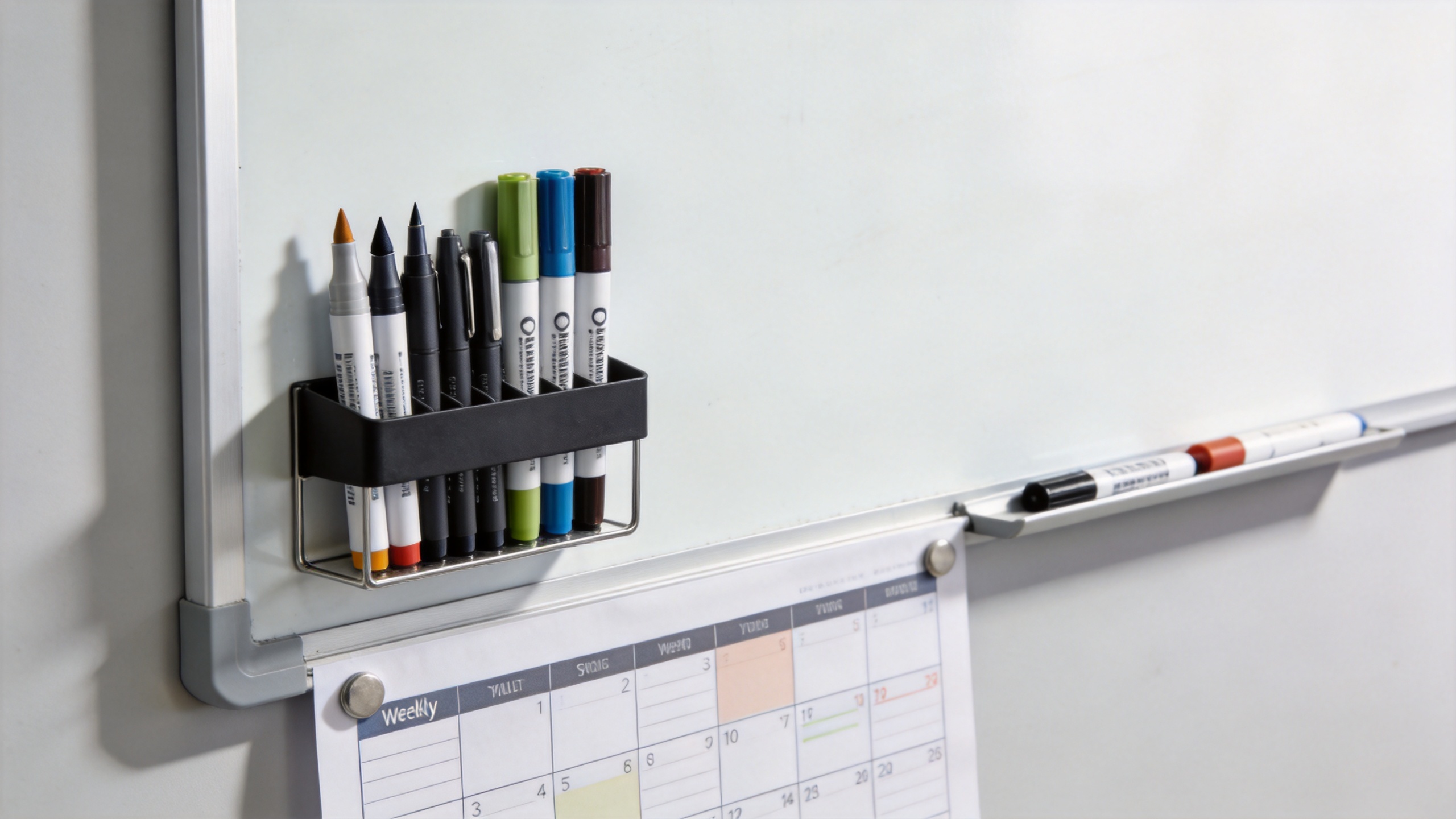
The marker cannot compensate for an unsuitable writing surface. Painted steel boards can be a practical option for routine use, but coating quality and cleaning habits matter. Porcelain-on-steel surfaces are commonly selected where high-frequency use and durability are priorities. Glass boards offer a smooth, non-porous writing face, though their magnetic behavior depends on the board construction rather than the glass alone. So, a magnetic whiteboard marker should be selected alongside—not after—the surface specification.
Think through the use case. A family using a weekly schedule maker may value a compact magnetic surface that fits a kitchen. A school may prioritize lower glare, a durable frame, and reliable space for magnets and learning cards. An office may choose glass for appearance but still need to confirm that both the board and a magnetic whiteboard marker holder will attach as expected.
Price is only one line in the decision. At first glance, the least expensive option can look attractive. In practice, unclear ink performance, weak storage magnets, or inconsistent board sizing can create more replacement work. A procurement comparison should separate the marker pack cost from the board, mounting, packaging, customization, and sample-review process. That gives buyers a clearer total-cost view without inventing a universal price range.
Custom dimensions are useful when a wall, teaching area, or planning zone does not fit standard board sizes. For a branded set, an OEM discussion can cover board dimensions, frame color, printed calendar layout, packaging, and the selection of a compatible magnetic whiteboard marker set. Confirm artwork, packaging requirements, production samples, and inspection points in writing. Do not assume that a marker, board, and magnetic accessory are compatible merely because they are purchased from the same catalog.
For buyers looking at product options, the CMS-confirmed catalog includes a customizable magnetic drywipe whiteboard and a magnetic dry-erase fridge calendar. Review the listed product details directly and request confirmation of the final configuration before ordering.
Use a clean, soft cloth or a cleaner intended for dry-erase surfaces, and avoid abrasive pads that can affect coatings. Cap each magnetic whiteboard marker promptly so the tip does not dry out. If ghosting appears, first check whether the surface is designed for dry erase and whether marks have been left for longer than normal. Regular light cleaning is easier than trying to remove a long buildup at the end of a term.
The right magnetic whiteboard marker is therefore a system decision: tip and ink for the writing task, a secure storage method, a compatible magnetic surface, and a buying process that verifies samples. Once those pieces align, the board is far more likely to support planning, teaching, and collaboration every day.

2026/08/20
Unlock flexible, repositionable whiteboarding for education, agile offices, retail, healthcare & more. Cuttable, magnetic, certified — request your free B2B sample today.

2026/10/10
Discover the 2027 Texture Magnetic Collection & Exclusive Exhibition Promotions Dear Global Partners and Valued Clients, We are thrilled to announce that Shenzhen U&U Magnetic Technology Co., Ltd. (Brand: UCMD) will be officially exhibiting...

2026/08/19
Discover how UCMD® leverages the Canton Fair to showcase magnetic educational & lifestyle products, build global buyer trust, and drive OEM/ODM partnerships. Explore our certified, customizable solutions today.

2026/08/28
Our Commitment to People, Planet & IntegrityAt ShenZhen U&U Magnetic Technology Co., Ltd. (UCMD®), we believe that how we make our products matters as much as what we make. From our factory floor in Shenzhen's Bao An District to the hands...

Please tell us about your company's advantages and characteristics.

Please tell us about your company's advantages and characteristics.

Please tell us about your company's advantages and characteristics.

Please tell us about your company's advantages and characteristics.

Please tell us about your company's advantages and characteristics.

Please tell us about your company's advantages and characteristics.

