 EN

Magnetic Whiteboards for Offices
Please tell us about your company's advantages and characteristics.
2026/10/16
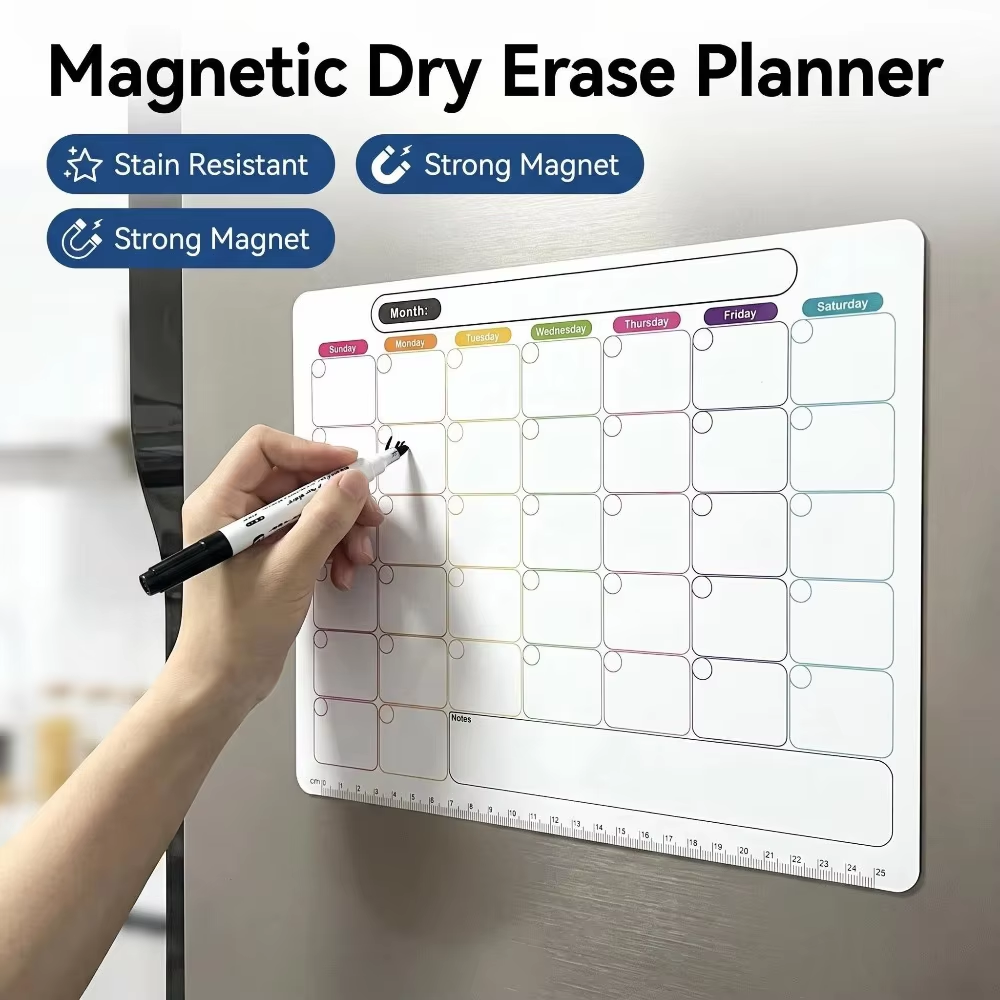
A dry erase calendar monthly format looks straightforward until you need hundreds of matching units delivered to several locations. A chain retailer wants shelf-ready cartons, a school district wants consistent layouts, and an ecommerce seller needs packaging that survives parcel handling. The practical purchase decision is not simply “wall board or fridge board.” It is whether the size, grid, material, packaging, artwork process, and document trail fit the program you are building.
From an education-supplies distributor’s perspective, uniform specifications and low after-sales friction matter more than a single board’s appearance. Start by defining where each dry erase calendar monthly board will be viewed, how much writing room each date needs, and whether the buyer needs a magnetic surface, an accessory set, or a retail-ready package.
Many bulk buyers assume a bigger board automatically creates a better planning tool. That is not automatically true. In a narrow staff room or a small classroom, an oversized grid can put dates outside a comfortable viewing angle; in a warehouse office, a compact board can leave too little room for shifts and delivery notes. Ask the end user a simple question: how many people must read or write on the dry erase calendar monthly at the same time?
For desk, refrigerator, or compact office use, A3 is often a practical starting point. A2 provides more date-cell space for shared rooms, while a 60 × 45 cm format can suit a visible team-planning zone. Larger wall formats may be appropriate for operations teams, but request the actual monthly grid dimensions rather than relying on an outside measurement alone. A big wall calendar dry erase layout should leave enough room for handwriting after the day numbers, weekends, and notes area are printed.
The board face should be specified as carefully as the board size. A standard seven-column month grid works for general scheduling. A notes panel supports recurring tasks, and a side column can help a store manager track campaigns or replenishment. A multi month dry erase calendar is useful when users compare deadlines across several months, but it divides the writing area; that trade-off should be visible in the approval sample.
If your assortment includes calendars magnetic refrigerator formats, confirm the intended surface and backing construction in the sample review. A magnetic board that works on one refrigerator door may not attach to a non-magnetic appliance panel. That is a usage check, not a claim to make from product photography.
A purchase order for a dry erase calendar monthly should define more than a quantity and a color. Write down the finished dimensions, board thickness or construction requested, grid artwork version, frame or corner treatment, backing type, marker and accessory inclusion, logo position, individual package, inner pack, master carton, and destination label requirements. This turns an attractive sample into a repeatable specification.
It also makes supplier quotations comparable. One factory may quote an unboxed board while another includes a marker set, retail sleeve, and export carton. Ask for a line-by-line quotation that separates tooling or artwork setup, sample charge, unit price by quantity tier, packaging, inspection, and freight terms. MOQ is usually linked to material setup, printing method, packaging, and customization complexity; it is not a universal number that can be responsibly assumed.
Monthly calendars are vulnerable to corner damage, surface scratching, print abrasion, and warping if cartons are under-specified. For a bulk program, request a packaging drawing or pack-out description that shows protective film, corner protection where relevant, inner-box quantity, master-carton count, carton dimensions, gross weight, and pallet plan. If you are buying a big wall calendar dry erase design, verify whether it ships flat, rolled, or with a frame because each option changes the damage profile and warehouse handling.
Before mass production, approve a sample that has the final grid, logo placement, and package components. Then align the inspection checklist to the issues that create returns: legible date lines, clean print registration, eraseability appropriate to the specified board surface, flatness after unpacking, and complete accessories where they are included. Avoid promising a specific performance result unless it is supported by the agreed inspection method.
OEM customization can include a logo, brand colors, localized weekday labels, a notes section, or channel-specific packaging. Keep the monthly grid readable first. A proof should show the logo scale, safe margins, contrast, and handwriting space at the actual finished size. For a multi month dry erase calendar, ask the designer to protect the legibility of month labels and small day cells before adding promotional graphics.
For buyers sourcing from a specialist magnetic-products manufacturer, it can be efficient to consolidate compatible planner formats and related magnetic products in one program. That only helps if the supplier can maintain the approved artwork, packing specification, and revision control across replenishment orders. Confirm how artwork changes, samples, and production approvals are documented.
Supplier evaluation should combine practical manufacturing questions with market-specific document checks. Request recent examples of comparable calendar-board packaging, a clear sample-to-mass-production approval path, and a defined inspection process. For products intended for children, bundled markers, or regulated destinations, ask which documentation applies to the exact construction and sales market. Do not treat a generic certificate image as proof that every calendar configuration or accessory set is covered.
The right question is: “What test reports, material declarations, or compliance documents can you provide for this finished configuration and destination?” That keeps the review grounded. It also helps buyers separate a general dry erase calendar monthly office product from a program that has child-focused accessories or country-specific requirements.
When comparing format directions, you can review a compact A3 dry erase calendar for refrigerator, office, or desktop use, a reusable magnetic fridge calendar with monthly and weekly planning, or a magnetic planner board with monthly planning capability. Treat these as starting points for a conversation about format and link them to the approved specification, rather than assuming their listed names establish every feature needed for your program.
A dependable dry erase calendar monthly program begins with a clear use case and ends with a controlled specification. Size, writing area, layout, packaging, logo treatment, and document review each affect the landed result. When those points are documented before mass production, buyers can compare suppliers fairly, protect the end-user experience, and make repeat orders with fewer surprises.

2026/08/20
Unlock flexible, repositionable whiteboarding for education, agile offices, retail, healthcare & more. Cuttable, magnetic, certified — request your free B2B sample today.

2026/10/10
Discover the 2027 Texture Magnetic Collection & Exclusive Exhibition Promotions Dear Global Partners and Valued Clients, We are thrilled to announce that Shenzhen U&U Magnetic Technology Co., Ltd. (Brand: UCMD) will be officially exhibiting...

2026/08/19
Discover how UCMD® leverages the Canton Fair to showcase magnetic educational & lifestyle products, build global buyer trust, and drive OEM/ODM partnerships. Explore our certified, customizable solutions today.

2026/08/28
Our Commitment to People, Planet & IntegrityAt ShenZhen U&U Magnetic Technology Co., Ltd. (UCMD®), we believe that how we make our products matters as much as what we make. From our factory floor in Shenzhen's Bao An District to the hands...

Please tell us about your company's advantages and characteristics.

Please tell us about your company's advantages and characteristics.

Please tell us about your company's advantages and characteristics.

Please tell us about your company's advantages and characteristics.

Please tell us about your company's advantages and characteristics.

Please tell us about your company's advantages and characteristics.

