 EN

Magnetic Whiteboards for Offices
Please tell us about your company's advantages and characteristics.
2026/09/26
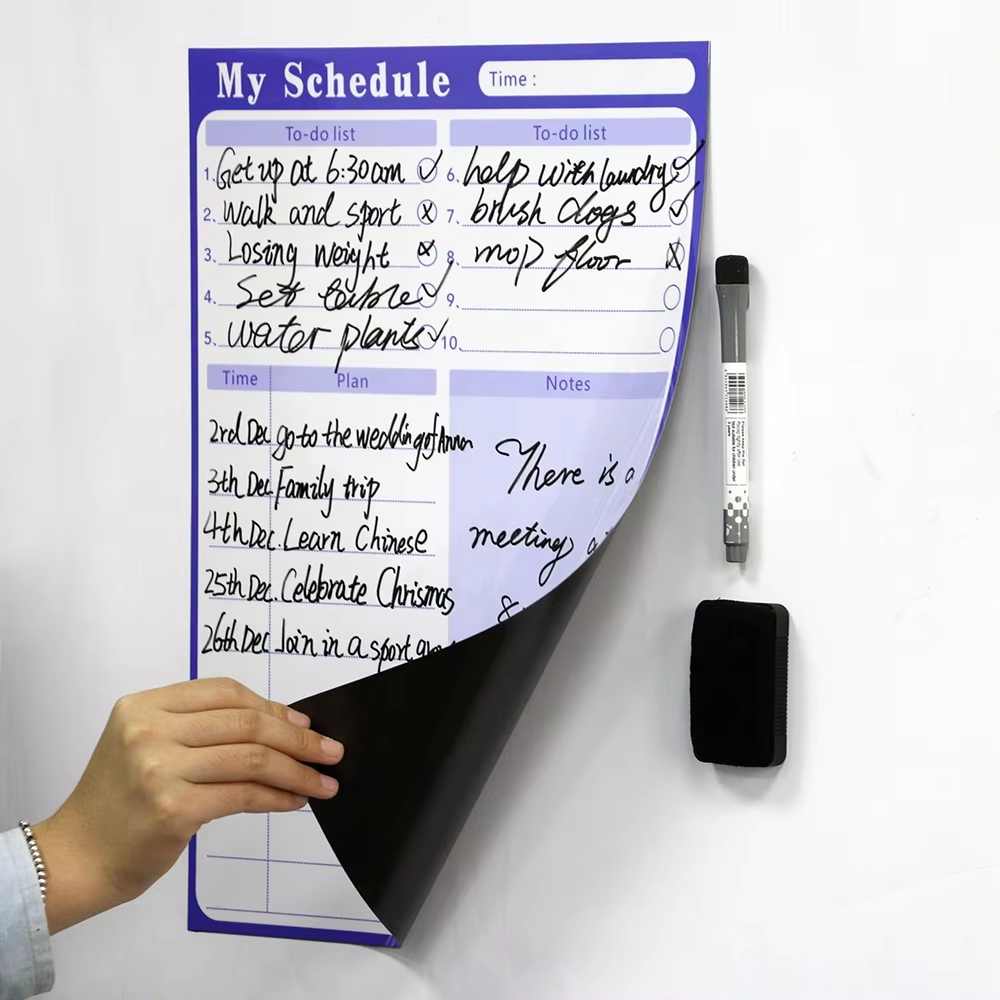
When a team needs one surface for meeting notes, schedules, project cards, and changing announcements, a magnetic board for wall large is more than a bigger version of a desktop board. It becomes a shared visual workspace. As a magnetic-products adviser, I suggest starting with the wall and the workflow—not with the biggest board on a catalog page. That order helps facilities teams avoid a board that looks impressive but leaves too little writing area, overwhelms a narrow corridor, or creates an installation problem after delivery.
Large magnetic boards are particularly useful in meeting rooms, training areas, classrooms, reception zones, and production offices. They keep paper notices, magnetic labels, and dry-erase content in one place. A small dry erase desk accessory can still suit personal task tracking, but it cannot replace a wall surface that several people need to read and update together.
A compact board is fine for a single to-do list or a few photos. Once several people contribute content, however, its usable space disappears quickly. Notes overlap, magnets cover writing, and viewers at the far end of the room cannot read the content. A magnetic board for wall large gives each activity its own zone: agenda on one side, working notes in the center, and follow-up actions on the other.
That division is often the practical advantage in collaboration. Instead of erasing one conversation to make room for the next, a facilitator can preserve decisions while the group continues. In education, a larger board also lets teachers separate instructions, examples, and student work. For household organization, a meal planning whiteboard may need less total surface, but it still benefits from a visible weekly grid and enough margin for grocery or reminder magnets.
Market listings commonly include large formats such as 24 × 36, 24 × 48, and 24 × 60 inches, while some wall-mounted dry-erase options reach 72 × 48 inches. Those examples are useful starting points, not universal rules. The right magnetic board for wall large depends on how many people read it, how far away they stand, and how much uninterrupted wall area remains after doors, switches, screens, and furniture are considered.
| Typical use | Practical starting range | What to reserve on the board |
|---|---|---|
| Small team room or tutoring area | About 24 × 36 to 24 × 48 inches | One working canvas plus a side area for magnets |
| Classroom or active project room | About 36 × 48 to 48 × 72 inches | Separate instruction, work-in-progress, and reference zones |
| Reception, operations, or training wall | Multiple panels or a custom wide layout | Readability from a distance and clear content ownership |
Before asking for a quote, draw the usable rectangle on the wall with removable tape. Stand where users will normally sit or walk past. If text in the planned writing area is difficult to see, adding width may help; if the board forces people to stand too close to read the top row, mounting height or layout may be the real issue. More area is valuable only when it stays accessible.

For a magnetic board for wall large, the decision is not just white versus colored. Buyers should confirm whether the surface supports the magnets they plan to use, whether it is meant for dry-erase writing, and whether glare will affect the room. A white glass whiteboard can create a clean, modern appearance, but its reflectivity and mounting method deserve review in a bright room. A conventional magnetic dry-erase surface may suit fast-changing workshop or classroom information when frequent writing and erasing are the priority.
Panel layout matters too. One continuous board gives a clean shared canvas; several aligned panels can simplify transport, make replacement more manageable, and allow different zones to have different functions. In either case, ask the supplier which portion of the visible face is actually usable after frames, fixing points, and accessory rails are considered. The nominal outside dimensions can differ from the working area.
Wall measurement is a procurement step, not an installer’s afterthought. Record width and height, then note door swings, windows, outlets, sprinklers, display screens, and any required clearance. Measure the proposed mounting height from the finished floor and make sure the bottom edge does not conflict with chairs, carts, or cleaning equipment.
Next, identify the substrate: masonry, concrete, wood framing, metal framing, or drywall. A large board should be mounted with hardware appropriate to that substrate and to the board’s documented weight and fixing pattern. Drywall is a finish surface rather than the structural support; where possible, distribute the load into suitable framing or use a supplier-approved fixing approach. Do not assume that a generic anchor rating applies to every wall, board, or installation orientation.
For a magnetic board for wall large, the unit price is only one line in the buying decision. Material choice, dimensions, frame or edge treatment, printing, color, accessory rails, quantity, export packaging, and shipping method can all change the quote. Custom branding or printed grids can be useful for recurring workflows, yet they may add setup work and longer lead times. The sensible comparison is a like-for-like specification: same face material, thickness, size, mounting kit, packaging level, and delivery terms.
Batch purchasing can reduce repeated setup and freight handling, especially when several rooms use the same standardized format. Still, it is worth approving one sample or a pilot installation when the wall condition, color match, or printed layout is important. A supplier’s catalog can help you compare formats, including a customizable magnetic culture-wall whiteboard and a customizable magnetic dry-wipe board. Confirm final suitability, dimensions, and installation details directly against the product specification before ordering.
Oversized panels are awkward to move and can be damaged by corner impacts or flexing. Plan a clear delivery route from vehicle to room, including elevators, stair turns, doorway widths, and a clean staging area. Keep protective film and corner protection in place until the board is ready to mount. For large or glass-faced panels, use enough people or professional handling equipment to avoid twisting the face.
After mounting, inspect the board while the installer is still on site: check level, fastener coverage, frame alignment, surface condition, and magnetic response with the intended magnets. Then give users a simple care routine: use compatible markers and erasers, avoid abrasive cleaners, and remove residue promptly. This is a small discipline, but it protects a shared magnetic board for wall large from becoming a dull, hard-to-read fixture.
A well-matched magnetic board for wall large is not automatically the widest model. It is the board whose format, surface, mounting plan, and purchase specification fit the people who will rely on it every day.

2026/08/20
Unlock flexible, repositionable whiteboarding for education, agile offices, retail, healthcare & more. Cuttable, magnetic, certified — request your free B2B sample today.

2026/10/10
Discover the 2027 Texture Magnetic Collection & Exclusive Exhibition Promotions Dear Global Partners and Valued Clients, We are thrilled to announce that Shenzhen U&U Magnetic Technology Co., Ltd. (Brand: UCMD) will be officially exhibiting...

2026/08/19
Discover how UCMD® leverages the Canton Fair to showcase magnetic educational & lifestyle products, build global buyer trust, and drive OEM/ODM partnerships. Explore our certified, customizable solutions today.

2026/08/28
Our Commitment to People, Planet & IntegrityAt ShenZhen U&U Magnetic Technology Co., Ltd. (UCMD®), we believe that how we make our products matters as much as what we make. From our factory floor in Shenzhen's Bao An District to the hands...

Please tell us about your company's advantages and characteristics.

Please tell us about your company's advantages and characteristics.

Please tell us about your company's advantages and characteristics.

Please tell us about your company's advantages and characteristics.

Please tell us about your company's advantages and characteristics.

Please tell us about your company's advantages and characteristics.

