 EN

Magnetic Whiteboards for Offices
Please tell us about your company's advantages and characteristics.
2026/10/12
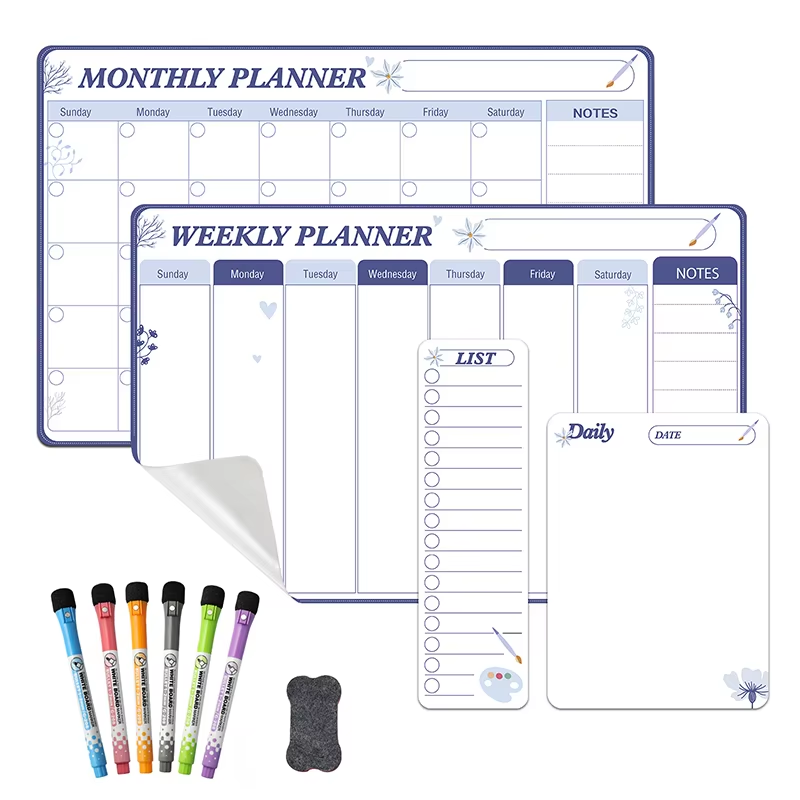
An undated weekly planner is built for real routines rather than an idealized calendar year. You add the dates only when you need them, begin in any week, and leave a busy or quiet period blank without feeling that the planner has been wasted. When that flexibility is combined with a visible, reusable board, planning becomes a shared habit instead of another tab to open.
For a household, student apartment, or small team, a board can make the week easier to see at a glance. For retailers and wholesale buyers, the same format answers a practical product need: customers want a planning tool that does not become obsolete on January 1. A suitable choice is not automatically the largest board or the one with the most boxes. It is the one whose layout, writing area, and display location fit the way people actually plan.
A dated format is useful for routines that run steadily from month to month. An undated weekly planner is more forgiving when school terms, travel, projects, family care, or seasonal work interrupt that rhythm. Instead of flipping past unused printed weeks, users label the current week and pick up where they left off. That simple difference suits people who plan in bursts as well as people who plan every day.
On a reusable board, the benefit is especially visible. A week can be reset with a wipe, then rewritten with fresh priorities. This makes a weekly planner magnetic board a practical shared reference point for a refrigerator, office corner, or study area. It also creates a useful planning prompt: what must happen this week, what can wait, and who owns each task?
| Planning need | Undated board | Dated board |
|---|---|---|
| Starting midyear | Ready whenever the user is ready | May include earlier dates that will not be used |
| Skipping a week | No empty preprinted week to work around | Can be better for a continuous archive |
| Sharing tasks at home | Easy to relabel and reset for a changing household rhythm | Useful when the same fixed dates matter every week |
| Retail or OEM positioning | Appeals to flexible, reusable planning routines | Appeals to buyers who prefer ready-labeled calendar structure |
The comparison is not a verdict against dated products. If a school office needs a fixed-term overview, printed dates can reduce setup time. But if the planner will be paused, moved between users, or refreshed as priorities change, an undated weekly planner removes unnecessary friction.
A weekly whiteboard planner for fridge is most useful when it is positioned where routines already overlap. Use one row for meals or appointments, one for school and work commitments, and a small area for tasks that anyone can claim. Keep the first setup modest. Too many categories can turn a board into background decoration. A clear weekly view is easier to keep current.
Students can use an undated weekly planner to map deadlines, study blocks, and personal commitments without discarding weeks during holidays. Freelancers can use it to separate deliverables from follow-ups and leave space for the next active project. In both cases, a layout with room to revise is more useful than a rigid time grid if the days rarely unfold exactly as planned.
A large weekly whiteboard planner can support a visible Monday-to-Friday rhythm for a small team. Before choosing one, decide whether the board is for deadlines, staffing, customer follow-up, or a mix of all three. The answer determines how much writing space is needed per day. A larger board is not automatically more useful: a large format needs a viewing distance and a wall or surface where the team will actually notice it.
This is where an undated weekly planner earns its flexibility. A skipped week is simply skipped. A busy week can be expanded with notes. A quiet week can stay light. The board follows the routine rather than imposing one.
For a planning-board range, broad appeal often comes from practical choices rather than decorative complexity. Confirm the intended use case first: refrigerator planning, desk planning, classroom organization, or wall-mounted team planning. Then discuss the weekly grid, notes area, erasable surface, magnetic or mounting approach, marker storage, packaging, and any custom printing. Buyers should request confirmed product specifications and samples before committing to a larger program rather than assuming a layout will suit every market.
Customization can also make the weekly planner magnetic board easier to merchandise. A retailer may want its own color system, local-language labels, a logo area, or a layout designed around a particular customer group. Consistency matters in a larger order: dimensions, print legibility, and included accessories should be reviewed as a complete set. A supplier with OEM/ODM and custom-printing capability can help turn a general weekly layout into a branded planning product, but final specifications should be documented and approved.
If you are comparing formats, review the layout and placement needs alongside the product page details. A Weekly Planner Magnetic Board Dry Erase Monthly Planner Whiteboard for Fridge is relevant when a kitchen-centered planning location is the priority. For a removable option, consider the Reusable Silicone Calendar Removable Weekly and Monthly Planner with To-Do List for Office and Home Use Whiteboard Genre. These links are starting points for format comparison, not claims about unlisted specifications.
The right undated weekly planner gives users permission to start now, pause when life changes, and return without wasting a calendar. Select the board around its viewing location, the number of people who will use it, and the amount of writing space the routine requires. With a simple reset ritual and an adaptable layout, flexible planning can stay clear, shared, and easy to maintain.

2026/08/20
Unlock flexible, repositionable whiteboarding for education, agile offices, retail, healthcare & more. Cuttable, magnetic, certified — request your free B2B sample today.

2026/10/10
Discover the 2027 Texture Magnetic Collection & Exclusive Exhibition Promotions Dear Global Partners and Valued Clients, We are thrilled to announce that Shenzhen U&U Magnetic Technology Co., Ltd. (Brand: UCMD) will be officially exhibiting...

2026/08/19
Discover how UCMD® leverages the Canton Fair to showcase magnetic educational & lifestyle products, build global buyer trust, and drive OEM/ODM partnerships. Explore our certified, customizable solutions today.

2026/08/28
Our Commitment to People, Planet & IntegrityAt ShenZhen U&U Magnetic Technology Co., Ltd. (UCMD®), we believe that how we make our products matters as much as what we make. From our factory floor in Shenzhen's Bao An District to the hands...

Please tell us about your company's advantages and characteristics.

Please tell us about your company's advantages and characteristics.

Please tell us about your company's advantages and characteristics.

Please tell us about your company's advantages and characteristics.

Please tell us about your company's advantages and characteristics.

Please tell us about your company's advantages and characteristics.

