 EN

Magnetic Whiteboards for Offices
Please tell us about your company's advantages and characteristics.
2026/10/09
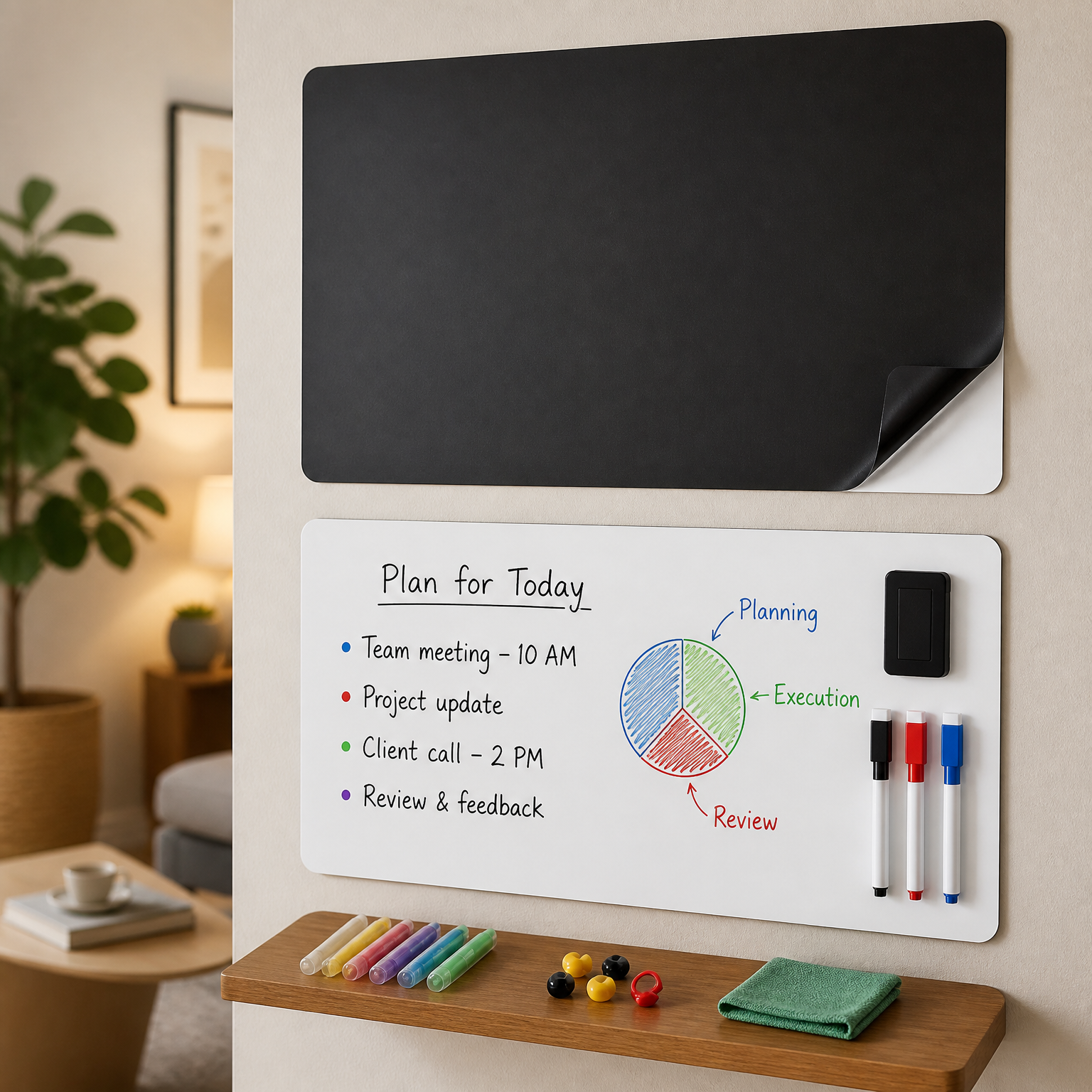
A dry erase board for wall use is simple to describe but surprisingly varied to buy. A school may need a high-wear teaching surface, an office may need a planning hub, and a retailer may need a compact magnetic item for home organization. The right choice begins with the work the board must do—not with the largest size or lowest quote.
For distributors and institutional buyers, a dry erase board for wall installation is also a sourcing decision. You need to align surface material, effective writing area, mounting method, packaging, and repeat-order consistency. The guide below provides a practical framework for homes, workplaces, and education settings.
In homes, a dry erase board for wall placement near an entry, study area, or kitchen can hold routines, shopping notes, and weekly plans. A fridge whiteboard suits small, metal-surface reminders; it is useful, but it is not a substitute for a full-size mounted board when several people need to see and update information.
In offices, a dry erase board for wall setup works well for stand-ups, shift handovers, project milestones, and visitor-facing schedules. Teams that revise information many times a day should prioritize wipeability and low ghosting over decorative features. In classrooms and training centers, the same product becomes a writing and display surface, so viewing angle, glare, edge safety, and magnetic accessory use matter as much as the writable face.
For a huge white board, do not assume more area automatically improves communication. A board that extends beyond comfortable sightlines or reaches a doorway can make the outer zones less useful. Measure the clear wall width, obstacles, viewing distance, and the usable magnetic area inside the frame before approving a drawing.
The surface is the core quality decision for any dry erase board for wall project. Ask the supplier to identify the actual writing face and backing construction, not simply label a product “premium.”
| Surface option | Best fit | Buying considerations |
|---|---|---|
| Painted steel | General office, home, and moderate-use education | Often a practical magnetic option. Compare coating consistency, flatness, edge protection, and erase performance on a sample. |
| Porcelain enamel on steel | Busy classrooms, shared meeting rooms, and long-use institutional projects | Commonly selected for durable, nonporous performance. Confirm the full board construction, mounting system, and the supplier’s quality documentation. |
| Glass | Design-led offices, executive rooms, and premium interiors | Offers a modern appearance and stain-resistant surface, but weight, mounting requirements, marker visibility, and magnetic compatibility must be verified. |
A large dry erase board with a budget surface can be sensible for occasional planning; it may not be sensible for a class or team that writes and erases all day. Conversely, glass can be a strong visual choice where a polished finish matters, provided the wall and hardware are engineered for its load. There is no universal winner—usage frequency and installation conditions decide the fit.
Before ordering a dry erase board for wall, document wall material, usable width and height, nearby doors or switches, intended mounting height, and whether the board will be moved later. A board that fits on paper may be impractical once the frame, tray, and clearance are considered. For large panels, confirm fixing points and hardware with the installer rather than assuming every wall accepts the same anchors.
One common mistake is treating a huge white board as a single visual object rather than a working surface. Split the layout into zones: daily priorities, collaborative notes, schedules, or display space. If different teams need independent areas, multiple coordinated boards may be more useful than one oversized panel. Buyers should also ask whether the quoted dimension is outside-frame size or active writing area.
A repeatable dry erase board for wall program should start with a clear specification: dimensions, surface, frame style, backing, magnetic requirement, print or planner layout, accessories, mounting kit, packaging, inspection standard, and destination market needs. For private-label projects, request a pre-production sample or approval drawing before scaling.
U&U Magnetic’s confirmed company profile describes an OEM/ODM manufacturer of magnetic whiteboards, planners, and related magnetic products, with multiple material and size options. That can be relevant when a buyer needs custom dimensions, printed grids, or branded packaging. It is still wise to validate the exact product specification, sample, and product-specific compliance documents for the order at hand.
For reference, buyers can review a customizable magnetic wall whiteboard for a display-oriented application, a custom magnetic drywipe whiteboard for flexible magnetic-board sourcing, and a magnetic dry erase fridge calendar for the compact-home category.
When comparing quotes for a dry erase board for wall, treat price as a result of construction and service scope. Smaller painted-steel boards generally sit in an entry tier; a large dry erase board, porcelain-enamel construction, glass, custom printing, heavier frames, protective packaging, or specialized mounting increase the project cost. Freight and damage-prevention packaging can be material considerations for large panels.
Instead of accepting the lowest quote, compare like for like. Check the surface type, actual active area, board flatness, frame and corner finish, backing, magnet performance where required, mounting parts, scratch protection, carton design, and sample approval process. A lower initial price is not necessarily lower total cost if a board ghosts early, arrives damaged, or creates installation rework.
To keep a dry erase board for wall clean, erase fresh marker ink regularly with a clean, soft eraser or microfiber cloth. For residue, use a board-safe cleaner according to the surface supplier’s instructions, then dry the board. Avoid abrasive pads, harsh scouring powders, and unapproved solvents; these can dull or damage finishes. Do not leave permanent marker ink on the surface, and test any new cleaner on a small inconspicuous area first.
For a fridge whiteboard or a flexible magnetic sheet, avoid bending sharply and keep the writing face free of oily kitchen residue. For fixed boards, periodically check tray screws, frame condition, and mounting points. A suitable dry erase board for wall is one whose material, dimensions, mounting plan, and maintenance routine match the way people will actually use it.

2026/08/20
Unlock flexible, repositionable whiteboarding for education, agile offices, retail, healthcare & more. Cuttable, magnetic, certified — request your free B2B sample today.

2026/10/10
Discover the 2027 Texture Magnetic Collection & Exclusive Exhibition Promotions Dear Global Partners and Valued Clients, We are thrilled to announce that Shenzhen U&U Magnetic Technology Co., Ltd. (Brand: UCMD) will be officially exhibiting...

2026/08/19
Discover how UCMD® leverages the Canton Fair to showcase magnetic educational & lifestyle products, build global buyer trust, and drive OEM/ODM partnerships. Explore our certified, customizable solutions today.

2026/08/28
Our Commitment to People, Planet & IntegrityAt ShenZhen U&U Magnetic Technology Co., Ltd. (UCMD®), we believe that how we make our products matters as much as what we make. From our factory floor in Shenzhen's Bao An District to the hands...

Please tell us about your company's advantages and characteristics.

Please tell us about your company's advantages and characteristics.

Please tell us about your company's advantages and characteristics.

Please tell us about your company's advantages and characteristics.

Please tell us about your company's advantages and characteristics.

Please tell us about your company's advantages and characteristics.

