 EN

Magnetic Whiteboards for Offices
Please tell us about your company's advantages and characteristics.
2026/10/13
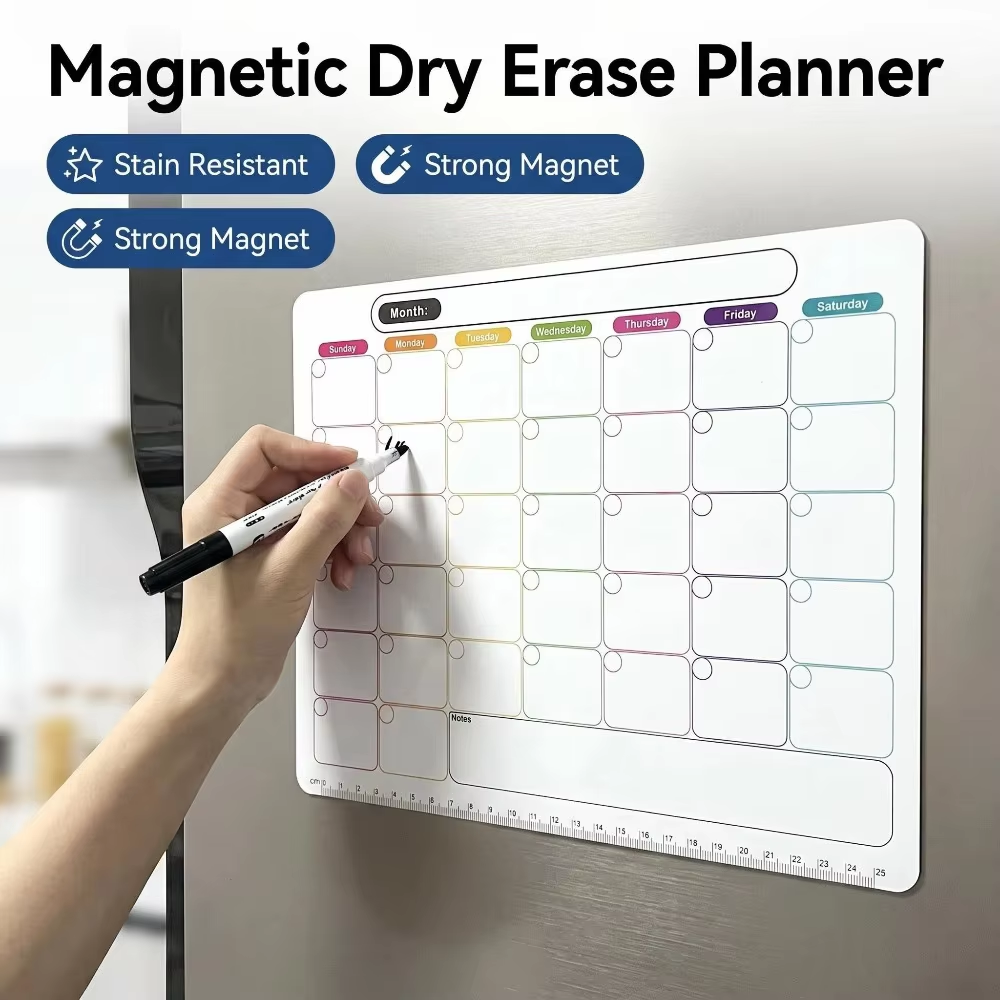
A weekly and monthly planner is most useful when it separates two decisions that are easy to blur: what matters this month and what must happen this week. A reusable board makes both views visible in the place where work, school, or family decisions actually happen. Instead of moving between a paper calendar, a phone app, and scattered notes, you can create one shared planning surface that is quick to update.
That does not mean a board replaces every tool. A phone calendar is still useful for alerts, and a paper notebook can be better for private reflection. The strength of a weekly and monthly planner board is visibility. It gives the group a common view of deadlines, routines, and next actions without asking everyone to open the same app.
Before choosing a layout, decide whether the board is mainly for household coordination, classroom routines, or a small team. The right weekly and monthly planner is not automatically the biggest one. A busy kitchen may need a clear monthly grid plus a short weekly meal and chores list. A teacher may need recurring lesson blocks and space for supplies. A small office may need project milestones at the month level and a weekly project planner area for owners and next steps.
A workable rule is to reserve the monthly section for commitments that are hard to move: appointments, launches, school dates, travel, billing dates, and deadlines. Use the weekly section for the actions that move those commitments forward. That distinction keeps the monthly grid from becoming so detailed that it is hard to scan.
At the beginning of each month, write only the anchors: fixed events, due dates, major campaigns, and milestones. Mark a small number of priorities beside the calendar rather than adding a long task list to every date. When several people use the board, assign a simple color or initial system and keep the key visible. If a color system requires a long explanation, it is probably too complicated for daily use.
The monthly section should answer, “What is coming, and what needs preparation?” It is especially useful for families coordinating activities, schools tracking events, and teams looking ahead before a deadline becomes urgent.
Once a week, pull only the relevant monthly items into the weekly area. Add the first actionable step, the person responsible, and any time-sensitive dependency. A wipeable weekly planner is helpful here because priorities change. Erasing and rewriting a task is not a failure of the system; it is the system reflecting new information.
For a planner with daily weekly and monthly pages, the same principle applies even if the daily view is a small side panel: the daily list should contain only the next few actions, not every idea you might do. The board remains easier to use when each layer has a distinct job.
| Tool | Best for | Watch for |
|---|---|---|
| Weekly and monthly planner board | Shared visibility, changing routines, and quick conversations | It needs a regular reset and a location people pass every day. |
| Paper planner | Personal notes, reflection, and portable planning | It is easy for a household or team to lose visibility when only one person has it. |
| Calendar app | Reminders, recurring appointments, and remote coordination | Important information can remain hidden until someone opens the app. |
Many people get a practical result by combining them. Keep fixed appointments in an app, use a paper planner for private notes, and let the weekly and monthly planner board show the shared commitments and near-term work. Think of the board as the prompt for a quick conversation, rather than a copy of every digital record.
For a fridge or other metal surface, a magnetic format keeps the planning area close to daily routines. A wall-mounted board may be a better fit where everyone needs a larger view, such as a classroom, reception area, or project room. Check the available surface, viewing distance, mounting method, and how often the schedule changes before selecting a format.
Look for enough writing space in both views, clearly separated columns, and a surface intended for dry-erase use. A board that is attractive but difficult to read from a normal standing distance tends to become decoration. Likewise, a layout with too many tiny boxes may work for a printed planner but feel cramped on a shared board.
For examples of formats that pair weekly and monthly organization, see this Weekly Planner Magnetic Board Dry Erase Monthly Planner Whiteboard for Fridge. Teams needing a combined calendar and task area can also review the Reusable Silicone Calendar Removable Weekly and Monthly Planner with To-Do List. These links illustrate product formats only; confirm the current specifications and suitability with the supplier before purchasing.
For distributors, schools, retailers, or branded-program buyers, a weekly and monthly planner is easier to source when the brief is specific. Start with the intended surface: refrigerator, wall, desktop, or mobile stand. Then define the finished size, orientation, calendar grid, weekly section, note area, and whether a to-do list is required. Ask for an artwork proof that shows real writing zones, not just a decorative design.
Next, discuss material and use conditions. The questions should cover magnetic backing or mounting method, board surface, marker compatibility, edge treatment, packaging, and the region where the product will be sold. If the board is expected to be wiped frequently, request information about care instructions and test a sample under the expected marker and cleaning routine. For branded programs, confirm logo placement, language, start-day preference, and whether the calendar is dated or undated.
U&U Magnetic lists magnetic planners among its product categories and supports OEM/ODM-oriented magnetic product development. For a fridge-focused format, the Reusable Magnetic Fridge Calendar Monthly & Weekly Planner with Dry Erase Markers is a useful starting point for a product conversation. A sample and a written specification remain more reliable than assumptions based on photos.
The most useful weekly and monthly planner is one people can update in under a few minutes. Keep markers and an eraser nearby, protect a small empty area for new items, and avoid turning every square into a category. If the board stops being current, do not redesign the entire system immediately. First reduce the number of things it is asked to track.
Use the monthly view to see the path ahead, the weekly view to decide what matters now, and a short daily list only when it helps you act. That rhythm gives a planning board its value: not more administration, but clearer choices and fewer missed handoffs.

2026/08/20
Unlock flexible, repositionable whiteboarding for education, agile offices, retail, healthcare & more. Cuttable, magnetic, certified — request your free B2B sample today.

2026/10/10
Discover the 2027 Texture Magnetic Collection & Exclusive Exhibition Promotions Dear Global Partners and Valued Clients, We are thrilled to announce that Shenzhen U&U Magnetic Technology Co., Ltd. (Brand: UCMD) will be officially exhibiting...

2026/08/19
Discover how UCMD® leverages the Canton Fair to showcase magnetic educational & lifestyle products, build global buyer trust, and drive OEM/ODM partnerships. Explore our certified, customizable solutions today.

2026/08/28
Our Commitment to People, Planet & IntegrityAt ShenZhen U&U Magnetic Technology Co., Ltd. (UCMD®), we believe that how we make our products matters as much as what we make. From our factory floor in Shenzhen's Bao An District to the hands...

Please tell us about your company's advantages and characteristics.

Please tell us about your company's advantages and characteristics.

Please tell us about your company's advantages and characteristics.

Please tell us about your company's advantages and characteristics.

Please tell us about your company's advantages and characteristics.

Please tell us about your company's advantages and characteristics.

